





|
Catholic Symbols
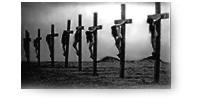
A Primer to Catholic SymbolismContributed to the Boston Catholic Journal by a Cloistered Poor Clare Colettine Nun (Click any link below to jump to it) _____________________________________________________________ Catholic Symbolism is an artistic representation, an outward expression, or a treasury of objects, that has shades of various, often hidden meanings. The most commonly used symbol is probably that of the Cross. For each of us, the Cross has various depths of meaning according to our life’s experience. This symbol can convey a wealth of ideas, concepts, scriptural quotes, experiences of suffering etc. We need symbols
in our spiritual journey, points of focus that lead us into
deeper prayer and each of them possesses a profound,
and often historical, spiritual dimension. _________________________________________________________________________
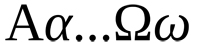
The Apha and the Omega — the Beginning and the End
“I am Alpha and Omega, the first and the last, the beginning and the end.” (Apocalypse 22.13) The Name Jesus takes to Himself in the last book of the New Testament: the Apocalypse or the Book of Revelation
_________________________________________________________________________
_________________________________________________________________________
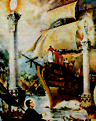
The Ship
Many of the early Church
Fathers refer to the Barque, the ship of Peter, the symbol of
the ship represents Holy Mother Church upon the high seas of
life.
_________________________________________________________________________
The Fish
The symbol of the fish
has been used from very early Christian times (second century)
— it can be found in the Catacombs of St. Callistus
(our16th Pope).
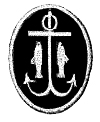
Iesous Christos Theou Yios Soter:
|

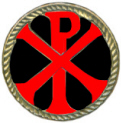
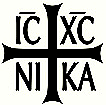
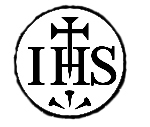
.gif)
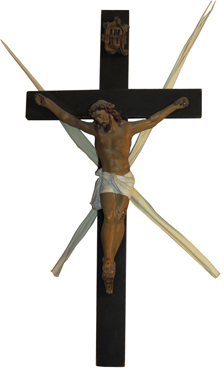
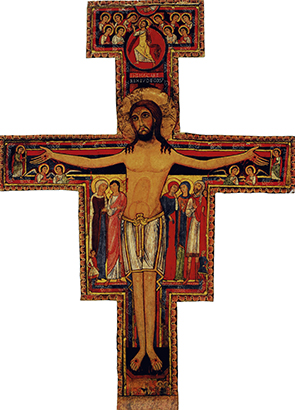
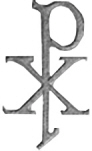
Greek Cross
A
Cross commonly |
St. Andrew’s Cross
A
saltire (X-shaped) cross |
|
|
|




The symbols above are of
interest to us as Catholics inasmuch as they underscore our
understanding of the development and journey of humanity ever
deeper and deeper into the God.
We should treasure and reverence the sign, the mark, the symbol
of the Cross, in darkness and suffering, it is the symbol that
will bring the greatest solace and blessing to our souls.
“We
adore you O Christ and we bless you, because by your Holy Cross
you have redeemed the world!”
_________________________________________________________________________
The Lamp
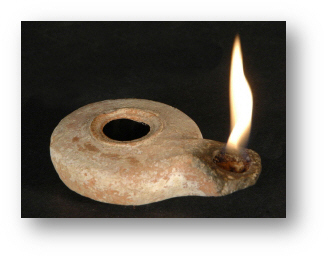
In
the time of Jesus the lamp was molded out of clay, it was
round and flat, had a pinching on one side to contain the wick,
and was fuelled with olive oil. (Olive oil had many uses and
was considered precious, as it was a valued foodstuff, also
it was a source of light, it could alleviate pain, cleanse wounds,
strengthen the sick, and mixed with perfume it was offered to
guests as a sign of respect).
The Lamp once lit, was placed on a stand and was never permitted
to go out, it burned, bringing warmth and light within the house
day and night. It was also regarded as being made for enlightenment,
and could symbolize vigilance, the prophetic word, and the presence
of God. It was a reminder to the Jew of the Holy Tabernacle,
and so therefore had deep religious significance.
In the book of Exodus, the Lord speaking through Moses says:
|
“And you shall command the people of Israel that they bring to you pure beaten olive oil for the light, that the lamp may be set up to burn perpetually. In the tent of meeting, outside the veil which is before the testimony, Aaron and his sons shall tend it from evening to morning before the Lord. It shall be a statute forever to be observed throughout all generations by the people of Israel.” (Ex. 27.20) |
Judaism was
the cradle of Christianity, and the light that burnt before
the Tabernacle in the wilderness was a forerunner to the Vigil
Light that ever burns before Jesus in the Most Holy Sacrament
of the Altar.
Lamps and lights have been used symbolically to represent the
life and existence of the soul, both among the living and the
dead. The Romans are said to have preserved lamps in some of
their sepulchers for centuries. In the papacy of Paul III, one
of these lamps was found in the tomb of Tullia (Cicero’s
daughter) which had been shut up for 1,550 years.
At the dissolution
of the monasteries a lamp was found which is said to have been
burning for 1,200 years. Two are preserved in Leyden Museum.
Jesus Christ is the Light of the World, the Light of the cosmic
world and the light of our inner world; He is the Light that
the darkness can never extinguish. His word is a lamp to our
path (Ps. 118). Lights are signs of hope, symbols that draw
us to the Eternal Light. A wonderful image of the vigilance
of the faithful awaiting the Second-Coming of Christ is found
in the Parable of the Wise and Foolish Virgins (Saint Matthew
25:1-13).
Lamps and light are bound to this world, to our earthly pilgrimage,
and we need the Light of Christ to bring us to the Blessed Kingdom
...
Light is only needful where darkness falls. Be it actual or
spiritual, let us follow the Light of Christ.
One day all flames will be extinguished, for He Alone will be
our Light:
|
“Then he showed me the river of life, clear as crystal, gushing from the throne and from the Lamb ... The throne of God will be in the city and God's people will live in His presence. They will see His face and His name will be upon their foreheads. There will be no more night. They will not need the light of lamp or sun for God Himself will be their light and they will reign forever.” (Apocalypse 22) |
Shine upon us, O Light of Christ!
_________________________________________________________________________
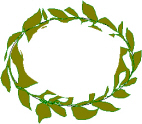
The Crown of Laurels
The
Laurel figures largely in history, even to this day. The
Laurel is an evergreen tree which carries large, oval, hardy
leaves. The Greeks gave a wreath, a crown (stephanos),
to the victor in the Pythian games. The Romans gave a crown
of triumph made of laurels to a general who obtained victory.
St. Paul likens the spiritual journey and mission to that of
a runner at the games.
“Have
you learned anything from the stadium? Many run, but only one
gets the prize. Run, therefore intending to win it, as athletes
who impose on themselves a rigorous discipline. Yet for them
the wreath is of laurels that wither, while we run for a wreath
that will never die.”
(1 Corinthians
9.24) We have all seen the recent spectacle of the Olympic Games
in Greece and elsewhere, the efforts that all participating
had to make, but they kept the goal ever in view. So we, too,
need to keep our eyes on Jesus, and run ahead for the crown
that awaits us in Heaven.
When a Poor Clare Sister makes her Profession of vows, the choir
sing, “Be
faithful unto death and I will give you the crown of life
”
When a sister dies, she is placed in her coffin fully dressed
in her habit, veil and kerchief, a crucifix in her hand, her
vow card upon her heart, and upon her head a crown of laurels,
interspersed with flowers, for she has run her race and now
awaits the crown of glory she will receive from her Lord.
There is a beautiful reading in the apocryphal book of 2 Esdras
chapter 2.42 onwards.
|
“I,
Ezdra, saw an enormous crowd on Mount Zion, too
many people to count. They were all singing and
praising the Lord.”
Standing in the middle of this crowd was a very
tall young man, taller than any of the others. He
was placing a crown on the head of each person,
but he towered above them all. I was spellbound
by the sight and I asked,
“Who
are these people Sir?” |
Let us keep
the goal in mind, let us keep our eyes on Jesus, Heaven awaits
us, all is passing ... Jesus will be our prize and the joy of
the Blessed Kingdom.
_________________________________________________________________________
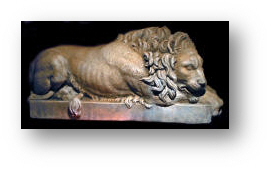
The Lion
The
lion is considered to be the
“King”
of all beasts, no doubt due to its great muscular power and
agility, its strength and ability to dominate all other species.
In its natural habitat it is indeed a magnificent creature.
Many great monarchs and Kings have taken the Lion as a title.
|
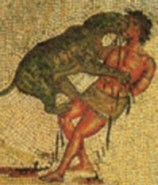
But the greatest to ever bear this name, is Our Savior, the Lord Jesus Christ. Jesus was a descendant of the principal tribe of Israel, the tribe of Judah. Jesus is the Lion of the tribe of Judah. The word Judah means, praise. He is the one to Whom all praise and honor are due, He is the Lion enthroned upon the praises of Israel. Jesus is the ruler, the King to Whom rightly belongs the blessing of Jacob.
“Judah, a young lion! You return from the prey, my son! Like a lion he stoops and crouches, and like a lioness, who dares to rouse him? The scepter shall not be taken from Judah, nor the rulers staff between his feet, until he comes to whom it belongs, and who has the obedience of the nations.” (Gen. 49.9-11 )
There are many
expressions of Lions within Heraldry, numerous postures being
assumed, as well as many stories pertaining to lions in Classical
mythology.
Probably the most familiar Christian symbol of the lion is applied
to St Mark, who is depicted as a lion. The origin of this is
said to be the fact that St. Mark begins his gospel with scenes
of John the Baptist and Jesus in the wilderness. Indeed at the
time of the writing of the gospels, lions still inhabited caves
within Palestine.
A less known
concept is the Lion as a symbol of the Resurrection. According
to tradition the lion's whelp is born dead, and remains so for
three days, and when the father breathes on it, it receives
life.
Probably the most beautiful usage of the lion imagery in recent
years are the allegorical stories of C.S Lewis,
“The
Chronicles of Narnia”,
in which the main figure is the lion, Aslan, (an image of Christ).
These stories are in one way timeless, showing the fight between
good and evil, of which Aslan is always the victor. The central
theme of, “The
Lion, the Witch and the Wardrobe”
within the Narnia Chronicles is the Pascal mystery.
One of the children in the story asks,
“What
does it all mean?”,
“It
means”,
said Aslan, “that
though the witch knew the deep magic, there is a magic still
deeper which she did not know. Her knowledge goes back only
to the dawn of time. But if she could have looked a little further
back, into the stillness and darkness before time dawned, she
would of read there a different incantation. She would have
known that when a willing victim who has committed no treachery
was killed in a traitor's stead, the Table would crack and death
itself would start working backwards.”
The symbol of the Lion is a powerful one, if you have not read
the chronicles of Narnia, please do, they are suitable for children
of all ages, as well as adults, and can be understood on many
levels.
The Lion of the tribe of Judah has conquered!
_________________________________________________________________________
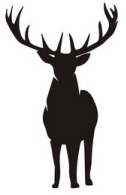
The Stag (Deer)
In Christian art the stag
has come to typify piety and religious aspiration and longing.
The Stag symbolizes solitude, prayer and purity.
“As
a Deer longs for running streams,
so my souls longs for You O, God.
My soul thirsts for the living God.”
(Psalm 42)
This beautiful
animal is possessed of such grace and majesty, and deservedly
is used to represent the human soul. Indeed the famous Victorian
engraver Edwin Landseer called the stag,
“The
Monarch of the Glen”.
His freedom of mobility captivates our imagination and speaks
to us of the freedom of soul we would like to have. His fearlessness
in combat is what we would like to imitate in our encounters
with evil.
Who could ever forget seeing the silhouette of this noble animal
against a lonely sky?
According to Pliny, the reason why the stag symbolizes Christ
is the superstition that it draws serpents by its breath from
their holes, and then tramples them underfoot.
The Stag is also depicted in artistic representations of some
Christian Saints, St Julian the Hospitaller, St Felix of Valois,
and St Aidan being among them.
“As
the deer longs for running streams ...”
Let us too long for the Living water symbolizing, the Word,
the Holy Spirit, Jesus Christ himself.
_________________________________________________________________________
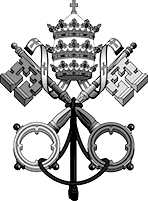
The Keys of the Kingdom
The Keys, permitting the
opening and closing of doors, symbolizes the one who possesses
authority and dominion over a kingdom.
In the book of the prophet Isaiah Ch 9, Verse 5-6 we read;
“A
Child is born to us, a Son is given us; the royal key is laid
upon His shoulder, and His name is proclaimed:
“Wonderful
Counselor, Mighty God, Everlasting Father, Prince of Peace.”
And in Isaiah chapter 22 verses 20-24 we read of Eliakim being
invested with authority and power, through the bestowing of
the key:
“On
that day I will summon my servant Eliakim, son of Hilkiah. I
will clothe him with your robe, I will strengthen him with your
girdle, I will give him your authority, and he will be a father
to the inhabitants of Jerusalem and to the people of Judah.
Upon his shoulder I will place the key of the house of David:
what he opens, no one shall shut; what he shuts, no one shall
open.”
The ancient keys were about a yard long, made of wood or metal.
On public occasions the steward placed the key on his shoulder,
hence to have the key upon one's shoulder meant to be in authority,
to have the keeping of something.
The power of the keys was given to St. Peter by Jesus Christ
himself;
“And now I say to you. You are Peter (or, the Rock) and on this rock I will build my Church; and never will the power of death overcome it. I will give you the keys of the Kingdom of Heaven; whatever you bind on earth shall be bound in Heaven, and what you unbind on earth will be unbound in Heaven.” (Saint Matthew 16:18-22)
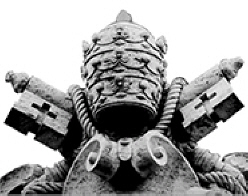
The power of the keys is the supreme authority vested in the
pope as successor of St. Peter. St. Peter is always represented
in Christian art with two keys in his hand, they are consequently
the insignia of the papacy, and are borne saltire-wise, one
of Gold and the other of Silver.
The supreme Pontiff has the God-given authority to open or close
the doors on the Treasury of the Faith and its practice, and
to unlock and reveal the truth to us as children of the Church.
Ours is to offer loving obedience to the Church, obedience in
the fullest sense of the word of listening and putting what
we hear into practice.
_________________________________________________________________________
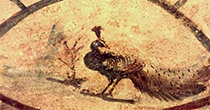
(Peacock from the Catacomb of Priscilla, Rome circa 3rd century A.D.)
The Peacock
The symbol of the Peacock was used
in art very early into the Christian era, it decorated some
of the tombs and walls in the actual catacombs. The Peacock
represented immortality, this stemmed from the ancient legend
that the flesh of the peacock did not decay, thus its association
with the Resurrection of Christ. In addition the
“multitude
of eyes" upon its stunningly beautiful fan tail, suggested the
all-seeing eye of God and that of the Church.
This beautiful bird is indigenous to India. It was brought to
King Solomon by his ships from Tarshish, in which case its origin
was probably the Malabar Coast or Ceylon.
It is a great pity that this colorful and captivating bird is
mostly associated in our minds as a symbolism of pride,
“Proud
as a Peacock".
“By
the Peacock!”,
was once a common oath which was thought to be sacred, precisely
because of it being a type of the Resurrection.
In the book of Genesis we read of Sarah's Egyptian slave-girl,
Hagar, being cast out into the wilderness. There in the desert
Hagar experienced God, as the One who Sees! In other
words, God was aware of the insecurity, pain and desolation
of her life; He saw, and had Hagar, with her unborn child, and
their future all in his heart and hand!
Hagar gave to The Lord who spoke to her, the name of El Roi,
for she said,
“I
have seen the One who sees me.”
That is why this well is called the well of Lahai-Roi.
(Genesis 16.13 )
We should take courage from this story, that whatever predicament,
trouble, trial we find our life to be in, God sees it all, He
KNOWS! And He is loving us through it, and calling us beyond
it ... He is the God Who sees! He notices us, small and insignificant
as we are.
Truly our God is a God of consolation.
Let us look upon the Peacock with new eyes and reflect on what
its eyes say to us!
_________________________________________________________________________
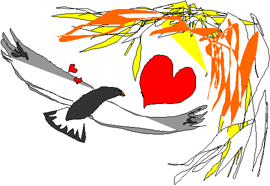
The Eagle
The eagle
is a magnificent bird with a large wingspan. It nests
in inaccessible rocky crags, in high places, which make it a
symbol of heavenly beings.
Job asked of God,
“Is
it at Your command that eagles fly, and build their nest on
high?”
(Job 39.27)
When the time comes for young eagles to learn to fly, the mother
takes one eaglet upon her wings and soars high above the land.
She then shakes the young one off to make its first attempts
at flight. If she sees her young in any trouble, she dives beneath
it, catches it on her wings and soars aloft again to repeat
the learning process.
The eagle is also often depicted as the bird that takes, carries
a person from danger up to a safe place.
“I
will bear you up, on eagles wings!”
one popular hymn tells us.
And from the book of Revelation we read of the woman who had
given birth to a male child (Jesus) and was in danger of being
consumed by the great dragon (the devil).
“Then
the woman was given the two wings of the great eagle so that
she might fly into the desert where she would be looked after
...”
(Rev. 12.14).
The eagle was used as an emblem long before the Christian era.
It was the ensign of the ancient kings of Babylon and Persia.
The Romans adopted it in conjunction with other devices, but
Marius made it the ensign of the legion.
The Romans also were accustomed to let an eagle fly from the
funeral pyre of a great emperor.
An Eagle in the heraldic language stands for fortitude.
An interesting
symbolic expression of the eagle is that seen on some lecterns
or ambos in churches. The eagle is the natural enemy of the
serpent. The two Testaments are the two outspread wings of the
eagle. On which can often be seen a large open Bible.
Its historical usage has led many to utilize the image to signify
power, authority and strength, among them Austria, Former Prussia,
and Russia, to name a few.
Many poets and artists have written about the eagle, and it
continues to fire the imagination of man.
Who can forget that wonderful scene from
“The Return
of the King”,
(The last film in the Ring Trilogy), where the hobbits Frodo
Baggins and Samwise Gamgee, their mission accomplished, sitting
upon a lonely craggy mound, surrounded by the disintegrating
mountain, and rivers of molten larva ... when all seems lost...
The exhilarating sight of the appearance of the great eagles
coming down to rescue them and carrying them away from the fire
and darkness!
The eagle in Christian art is emblematic of St. John the Evangelist,
because like the eagle he looked upon,
“the
sun of glory.”
The Word of God has the power to raise us up on eagles wings
and bring us to Heaven.
_________________________________________________________________________
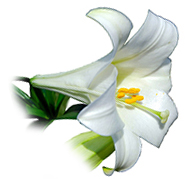
The Lily
The
Lily in Christian art is a well known symbol of chastity,
innocence and purity.
In pictures of the Annunciation, or Salutation, the Archangel
Gabriel is sometimes depicted holding a Lily branch, or Mary
herself is clasping a Lily, or there is a Lily in the vicinity.
“Hail
Mary fairest flower
O Lily glistening white and stainless!
I greet you at this time with
Gabriel's words sublime,
Ave O maid so highly favored!”
There is an old tradition that the Lily sprang from the repentant
tears of Eve as she went forth from paradise. Here Mary can
be seen as the New Eve, the Mother of life, who bore the fruit
that redeemed us all from sin and every fall.
The Lily in the language of flowers means,
“Majesty”.
The Lily as we know it today is a trumpet like flower, stately
and noble. Its large petals open and surrender to the light.
It exudes a beautiful perfume, and bears a high pollen yield.
The white Lily when it is full open resembles a star. It is
a flower of great beauty and it is easy to see why artists have
so often placed it within pictures of the Holy Virgin.
However in Biblical times Lilies, shushan was a collective
term for all the various flowers of the field, lilies, crocuses,
irises, tulips, narcissus, all of which came forth from a womb
like tuber.
“Blessed
is the fruit of thy womb!”
A solitary
symbol can be a great focus for reflection and prayer, perhaps
you would like to obtain a Lily and place it at your shrine,
prayer space, or take to the classroom. A lily is not very easy
to draw but a symbolic Lily could easily be made out of white
paper. It could be a catechetical focus and also to give added
meaning; put, or ask the children to place their prayer petitions
in its centre and then present the flower to Mary ... pray and
use these symbols creatively. They blossom, all of them, in
eternity.
_________________________________________________________________________
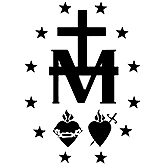
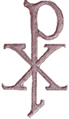
Signifying the union between
Jesus and Mary: Jesus Christ in the Incarnation took
His flesh from Mary even while He remained eternally
God with the Father. Hence, we state in the Nicene Creed that
Jesus is True God and True Man.
_________________________________________________________________________
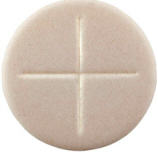
The Sacred Host imprinted with the Christogram
The Body of Jesus Christ — really and truly (not symbolically) — after Consecration by the priest during the Canon of the Mass and received by the faithful during Holy Communion. “Then Jesus said to them: Amen, amen, I say unto you: Except you eat the flesh of the Son of Man, and drink His blood, you shall not have life in you.” (St. John 6.53)
_________________________________________________________________________
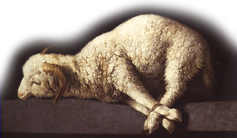
The Sacrificial Lamb of God — Jesus Christ
“The next day, John saw Jesus coming to him, and he said: Behold the Lamb of God, behold Him who taketh away the sin of the world.” (St. John 1.29)
________________________________________
To download any image, right-click
on it and choose:
“Save Link As ...” in Google Chrome or
“Save Image as ...” in Mozilla Firefox or
“Save Target as ...” in Microsoft Edge, and then
save it to your desktop.
by a Cloistered Poor Clare Colettine Nun in a
Papally Enclosed Monastery
For the Boston Catholic Journal

Totally Faithful to
the Sacred Deposit of Faith entrusted
to the Holy See in Rome
|