










|
A HELL OF A SITUATION
|
|
“The rich man also died and was buried and from the netherworld, where he was in torment ... [he cried out] I am suffering torment in these flames. ... warn them, lest they too come to this place of torment.’ ” (St. Luke 16:19-31) |
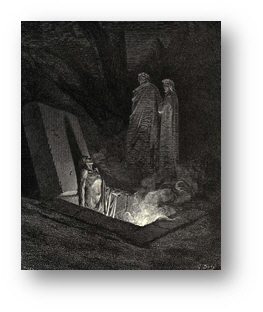
Contrary to “progressive” theological speculation, Hell has not been abolished ... nor has its rage abated. Look around you.
Like children fearing to invoke the very evil they fear through merely uttering it, we have somehow convinced ourselves that if we resolutely ignore Hell, it will go away; that if we pretend that there is no such place, then it will become a fiction and therefore we have nothing to fear ... and also nothing to avoid. It is — we are told, and therefore tell ourselves — a quaint vestige of pre-enlightened and distinctly medieval thought, of long gone days of dismal dogma; in fact a notion abolished after Vatican II as unkind, as severe, and therefore “unworthy” of God. This is not true.
But still, we whistle in the dark as we pass a
graveyard or a place of darkness fraught with a sense of looming evil. Odd. Very
odd.
Despite all that Christ has told us, all that Holy Mother the Church has taught
us, we will not hear of it ... we insist on our way. Christ knows this.
That is why He gives us the Parable of the Rich Man.1 Do you
doubt it?
Ask yourself this: have you ever (that is to say, even once) been to a funeral Mass where the bereaved are not told, indeed, completely assured, that their dead (who, like the rest of the congregation, had apparently never sinned) are already in Heaven smiling down benignly on our obsequies even as we utter them?
The real
illusion ... and it is not Hell
It matters not that “the departed” were cruel and miserly, utterly indifferent to the poor; that they profited from the pain, misery, sin and degradation of others, caring nothing for God and even less for men — and we know it! We knew it while yet they lived, and were ourselves often keenly aware of their selfishness, their lust, pride, and greed — even their open depravity. Unrepentant to the moment of that clap of thunder that ended the illusion of tomorrow, they went to death as they had lived — and we “celebrate their lives” ... instead of trembling before their death. In the lowest octave of our “celebration” we instinctively discern a deeply dissonant note that is discordant with our carefully revised narrative. It is deeper than the human voice, and more ancient still. We know that we “celebrate” a fiction of our own making to dispel the remorseless truth that stirs uneasily within us: that Heaven alone is not, after all, the abode of all our dead; that we have something to deeply lament, rather than celebrate; in fact something to fear rather than to rejoice in.
Incredibly, it became not just the same fiction but the narrative of Jorge Bergoglio (Pope Francis) — despite all that Christ said to the contrary!
Has the question, let alone the concern, of the dead’s urgent and utter need for every possible prayer ever once so much as arisen? Are we ever invited, urged, to so much as pray for our dead? * Are they not in need of our prayers? They were in life, yes? But somehow death appears to have abrogated this necessity. For all practical purposes and appearances, “being dead” is synonymous with “being canonized”. The dead, in every aspect of today’s liturgy, are, as it were, “by right” (and rite ...) — in virtue of the fact that they are dead — already “in the company of the Angels and Saints.”
Strangely enough, we acknowledge ourselves
to be sinners — if we acknowledge sin at all — but in a remarkable dispensation
that quite suddenly becomes concomitant with death, not the recently
departed ... who yesterday was “one among us”, that is to say, a sinner
also. What he needs most, the “celebrant” carefully contrives to conceal from
us: the need of our prayers. One day — perhaps this day
— I will need them ... and so will you.
We no longer pray for our dead
Why is this?
Praying for the dead is very closely connected to a sober recognition of the reality of ... other alternatives than Heaven. Lesser alternatives, frightening alternatives, even everlasting alternatives. We wish to spare our dead either a measure of that privative state of purgation preparatory to Heaven through the suffrage of our prayers, or were it possible, the pains of Hell through an impassioned petition to the Judge.
2 In any event, the outcome at least admits of doubt in terms of clearly distinguishable consignments.Monuments and mirrors
For many years we could find the following
inscribed on tombstones both in Europe and America:
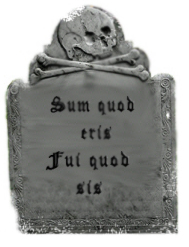
It was as much a reminder of the brevity of this life as an admonition to live our lives in recognition of realities that we cannot avoid, minimize, or simply wish away — and that these realities, moreover, will correspond with how we have lived.
Of two things we are certain: that we die, and that following our death we will either live forever or we will not.
If we do not live forever, we have nothing to hope for and nothing to fear. Whatever we are at the moment of our death, will be, as it were, the last syllable in an ill-stated premise of meaning that never purposed to attain to a coherent conclusion — because it could not. Without either hope or fear, then, we stare into the absence of being not as an eternal nothing, passively, if vacantly, witnessed in abstraction by a still inexplicable but nevertheless palpable consciousness aware of endless, unpunctuated, duration. we are an abstract argument against a plea for being. We are atheists which is a polite word for nihilists are atheists, and everything ultimately culminates in nothing. But if we are Catholics, we do — we have an abundance of the one or the other: either much to hope for — or much to fear.
We reject the first option offhand, that is to say, the notion that death brings total extinction. We are ... after all ... Catholics, and that flies in the face of everything Christ said and did.
But neither do we embrace the alternative (of either much to hope for or much to fear), at least in the eschatological terms enunciated by Christ Himself involving death, judgment, Heaven, and Hell.
We cannot have both.
Neither, then — in our preferential and subjective cosmology that accords with neither reason nor revelation — can we have a Heaven and a Hell. So we abolish Hell much in the way that we may succeed in abolishing Mount Aetna by our preferring to say that it is not there, despite persistent and troubling reports that it is.
Dives, the rich man in this parable, would
have a decidedly different opinion on the matter — were he present to offer it,
but Dives is being ... detained. Indefinitely. Even eternally. Or Christ is a
liar.
“Go to my brother”, he would importune us, as he did Abraham. Unfortunately, we
ourselves would tell him very much what Abraham told him: “It would be of no
avail.”
“They think you're in Heaven!”
The priest told them so; he assured them ... remember?
They think that you are looking down on them, having no clue that,
could you see, all that you would see of them would be the soles of their shoes!
It’s a hell of a situation: Priest, Rabbi, Minister, even their psychologists,
are all of one accord: there is no such thing as Hell. To which we respond:
“The Hell there isn’t!”
Ah, the price of constant gratification! Yes, such lies console the bereaved, but are a definite disservice to the dead who stand much in need of prayer and, could they tell you, would be eternally grateful for it.
But even if they did — like the rich
man in the parable — you would not believe them either ... would you?
_____________________________
* Of course, during the Mass the names of those who have died recently are, in fact, announced, and a perfunctory prayer is offered for them — but rarely with pleas for mercy since mercy presumes sin ... and the hope of forgiveness by God.
Editor
Boston Catholic Journal

Comments? Write us: editor@boston-catholic-journal.com
______________________________
1 “There was a certain rich man, who was clothed in purple and fine linen; and feasted sumptuously every day. And there was a certain beggar, named Lazarus, who lay at his gate, full of sores, desiring to be filled with the crumbs that fell from the rich man’s table, and no one did give him; moreover the dogs came, and licked his sores. And it came to pass, that the beggar died, and was carried by the angels into Abraham’s bosom. And the rich man also died: and he was buried in hell. And lifting up his eyes when he was in torments, he saw Abraham afar off, and Lazarus in his bosom: And he cried, and said: Father Abraham, have mercy on me, and send Lazarus, that he may dip the tip of his finger in water, to cool my tongue: for I am tormented in this flame. And Abraham said to him: Son, remember that thou didst receive good things in thy lifetime, and likewise Lazareth evil things, but now he is comforted; and thou art tormented.
And besides all this, between us and you, there is fixed a great chaos: so that they who would pass from hence to you, cannot, nor from thence come hither. And he said: Then, father, I beseech thee, that thou wouldst send him to my father’s house, for I have five brethren, that he may testify unto them, lest they also come into this place of torments. And Abraham said to him: They have Moses and the prophets; let them hear them. But he said: No, father Abraham: but if one went to them from the dead, they will do penance. And he said to him: If they hear not Moses and the prophets, neither will they believe, if one rise again from the dead.” (St. Luke 16.19-31)
2
Saint Luke 18.1-8
Geoffrey K. Mondello
Editor
Boston Catholic Journal
Comments? Write us: editor@boston-catholic-journal.com
|
Totally Faithful to
the Sacred Deposit of Faith entrusted
to the Holy See in Rome "Scio opera tua ... quia modicum habes virtutem, et servasti verbum Meum, nec non negasti Nomen Meum." "I know your works ... that you have but little power, and yet you have kept My word, and have not denied My Name." (Apocalypse 3.8)
Copyright © 2004
- 2025 Boston Catholic Journal. All rights reserved.
Unless otherwise stated, permission is granted by
the Boston Catholic Journal for the copying and
distribution of the articles and audio files under
the following conditions: No additions, deletions,
or changes are to be made to the text or audio files
in any way, and the copies may not be sold for a
profit. In the reproduction, in any format of any
image, graphic, text, or audio file, attribution
must be given to the Boston Catholic Journal. |