|
GHETTO CATHOLICISM
and
Our Need for Latin in the Mass
It was long overdue
...
even John Paul II noted:
|
“What is urgent is the evangelization of a world that not
only does not know the basic aspects of Christian dogma,
but in great part has lost even the memory of the cultural
elements of Christianity.” |
Benedict XVI recognized this as well. It was the proverbial
elephant in the room that no one wanted to acknowledge and which no
one could continue to ignore: the need for the restoration of Latin
to the Mass.
Americans — together with the English speaking world in
general — have always been reluctant to learn another language. The
prevailing attitude is one of cultural insolence: “Let the world learn
to speak English; we cannot trouble ourselves (or are simply too lazy)
to learn another language." Most Europeans will concur with this perception.
How often have you watched, listened, to a person from
Asia, Europe, Africa ... virtually any other country in the world, speak
in English (and generally good English) to a television reporter — and
had not asked yourself with verging embarrassment, “Imagine if that
were me ...?” How often have you cringed when you listened to the president,
or any prominent political figure in any of these parts of the world,
answer a reporter in English — when every single President
or Senator of the United States requires an interpreter during interviews
with foreign correspondents?
There is a somewhat mordant aphorism that circulates in Europe in the
form of two questions and an embarrassing conclusion:
Q:
“What is a person called who speaks three languages?”
A:
Trilingual.
Q:
“What is a person called who speaks two languages?”
A:
Bilingual.
Q:
“What is a person called who speaks one language?”
A:
American ...
Face it. We are either inexcusably lazy, culturally arrogant,
or intellectually incompetent.
You choose.
Pope Benedict is encouraging a return to the 2000 year historical
and intellectual heritage of Catholicism
in encouraging a return to
the very signature of its identity in the use of Latin in the Most Holy
Sacrifice of the Mass.
It is a reacquisition of an identity that cannot be expunged
from 2000 years of Latin texts, encyclicals, archives, inscriptions,
engravings, and every other expression unique to Catholicism — an identity
illicitly (Vatican II never abolished Latin) repudiated only in the
last ... mere 60 years.
What is really at the root of this aversion? Our comprehension of the
Mass (which so few really comprehend anyway, in any language (see
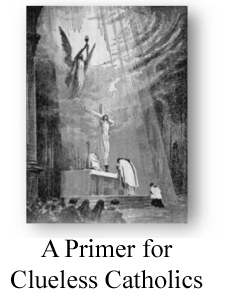
The Mass:
a Primer for Clueless Catholics)?
The readings, the Prayer of the Faithful, the homilies — all remain
in the vernacular. What then is your contention?
We are being asked to learn, or to re-learn, some prayers
— prayers that our mothers and fathers uttered from every generation
not just from century upon century, but from two millennia past.
That the the Mass is in great need of rehabilitation from
“entertainment” presided over by an MC — often as eager to amuse us
as the host of his own personality as to “intrigue” us with something
personally anecdotal and all too often utterly irrelevant ... to a focus
on the Sacrifice of the Mass, apart from which the Mass is
senseless — is unquestionable. Who has not been the sad witness to the
Priest as the comedian more eager to solicit laughter than prayers?
Who has not heard the uncomfortable laughter of the “congregation become
audience” in their attempt to attenuate the embarrassing caricature
they witness? “Solemnity” itself has become a “solecism”, more likely
to invoke derision than devotion. If one cannot see that the nature
of language in the Mass — and in the congregation — shapes, defines,
lends tangible substance to our spirituality, our assessment of ourselves
and our assessment of God ... then he is blind. This is why the Mass
stands in such dire need of remediation.
The Cenacle ... not Babel
What is more, it is becoming increasingly clear in an increasingly connected
and traveled world, that a common tongue in the language of worship
is becoming indispensable. When we gather as many nations in the one
faith, we speak as children of Babel and consequently
fail to understand what we hear — unlike those
who stood before the Cenacle when the Apostles first spoke
as one — and were understood by all!
This is our paradigm! One language ... understood by all!
Anyone who has visited St. Peter's in Rome can attest to
this fact: it is incredibly confusing to find a Mass celebrated in the
vernacular of a given country. I had attended a Mass in English celebrated
by an Irish Priest when a point came during Communion at which the Hosts
had been depleted. After Mass, I then had to run around to
various other Masses being celebrated in various other
languages to find a Mass at which the Hosts were still being distributed
in order to receive Holy Communion myself.
It is a suitably vexing fact that we — especially Americans
— cannot have all things at all times, and most travelers have been
to a Mass in which the homily and the Prayers of the Faithful had been
in a language not understood. We followed the Mass largely by following
the gestures and postures of the people around us, knowing equally,
by the gestures of the Priest, what part of the Canon of the Mass was
being celebrated. At such times we are struck by the fact that had at
least the Canon of the Mass been celebrated in a language we
all understood (not because we are all fluent in Latin, but
because we had all routinely attended Mass in Latin) we would have experienced
a greater sense of oneness in worship with those around us ... rather
than otherness.
What
then, I ask again, is your contention?
Are we really afraid that we will lose the spectacle of
a congregation turning a full 360 degrees and waving the obsolete “peace
sign” of the radical 60's to everyone in back, in front, and to all
sides? Will we really feel a sense of deprivation that we cannot
add our own personal — and often social — touch to each warm and fuzzy
greeting ... no matter how uncomfortable the person beside us feels
with either our overly effusive or utterly perfunctory frenzy? Do we
really feel that the Mass in Latin will deprive us of our blowing
kisses and winking and frenetically waving to those whom, on our way
out of the Church, we immediately proceed to calumniate with our gossip?
Ghetto Catholicism
Face it: in the English speaking world — and probably most other countries
— we have become so smug in our own little corner of Catholicism that
we find it far more acceptable to “pray in tongues” which no one understands
and never will, than to abandon our provincial arrogance and pray in
Latin which many of us do not presently understand but can easily learn.
There is something comfortable in the exclusivity of our ethnic and
cultural ghettos where we express Catholicism on our
terms, even if it isolates us from the rest of the Catholic world.
Consider this: of the 1.2 billion
Muslims worldwide (according to the Council on American-Islamic
Relations), all pray in Arabic,
although only 80% understand Arabic. Wherever a Muslim
goes, nothing separates him from his brother in prayer and worship.
Orthodox, among many other Jews, pray in Hebrew.
At
https://www.jewfaq.org/prayer.htm,
it is argued that, "There are many good reasons for praying in Hebrew...
it provides a link to Jews all
over the world ... and is the language of Jewish thought."
Why, then, are some Catholics so scandalized by
the prospect of praying in Latin?
Arabic is mandatory in Islamic prayer.
Hebrew is mandatory in Judaism.
Except in Saudi Arabia, Israel, and
about 25 other counties in the entire world neither language
that is used in prayer is the vernacular.
Where is the problem for Muslims?
Where is the problem for Jews? They hold a common (but not vernacular)
language to bind them despite distance and diversity.
“But we are
Catholics!” you say — not mindless and backwards Muslims or Jews ...
right?
We are much more “progressive” and “enlightened.”
Hebrew is
okay for Jews who do not speak Hebrew, and Arabic is okay for Muslims
who do not speak Arabic.
But Latin is unacceptable for Catholics who
do not speak Latin ...
Benedict, despite the predictably bad press, is rightly attempting to
re-establish an egregiously breached continuity in the Church ... a
vital continuity that pertains to an identity inseparable from Catholicism;
one which has always unified Catholics throughout the world in language
as well as teaching, and bringing with it a sacred dignity to worship,
in place of the often mindless but trendy inanities Catholics must now
endure at Mass in both the Liturgy and the appalling music.
If it is presently “correct” that Catholics are to be bashed for using
Latin, then it would appear that we must bash Muslims and Jews as well.
Oddly enough, we are inclined to do the one — and carefully refrain
from the others ...
Pourquoi? Warum? 为什么, Perchè?, Зачем?
... in other words, in American, “how come, huh?”
Editor
Boston Catholic Journal
 Printable
PDF Version
Printable
PDF Version
Comments?
Write us:
editor@boston-catholic-journal.com
Totally Faithful to the Sacred
Deposit of Faith entrusted to the Holy See in Rome
“Scio
opera tua ... quia modicum habes virtutem, et servasti verbum
Meum, nec non negasti Nomen Meum”
“I
know your works ... that you have but little power, and
yet you have kept My word, and have not denied My Name.”
(Apocalypse
3.8)
Copyright © 2004
- 2026 Boston Catholic Journal. All rights reserved. Unless
otherwise stated, permission is granted by the Boston Catholic
Journal for the copying and distribution of the articles
and audio files under the following conditions: No
additions, deletions, or changes are to be made to the text
or audio files in any way, and the copies may not be sold
for a profit. In the reproduction, in any format of any
image, graphic, text, or audio file, attribution must be
given to the Boston Catholic Journal.
|
|