|
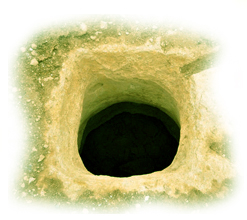
The Empty Cistern of Our Pain
“And he said mildly to them: Come nearer
to me. And when they were come near him,
he said: I am Joseph, your brother, whom
you sold into Egypt. Be not afraid, and
let it not seem to you a hard case that
you sold me into these countries: for God
sent me before you into Egypt for your preservation.
... Not by your counsel was I sent hither,
but by the will of God.” (Genesis 45.4-5+8)
The
Patriarch Joseph comes to us as a paradigm
of faith, mercy, and justice.
Joseph was loved by Jacob. He was the son of
his old age and Jacob doted upon him to the
growing resentment and jealousy of his brothers.
What is more, Joseph was “a dreamer”, whereas
his brothers were ... practical. The world has
little use for dreamers, but God is sometimes
the giver of dreams.
Predilection – favor by God or parent – is so
often the occasion of resentment. We feel somehow
“less” and desire the place of favor, honor,
notability. Why God’s predilection for Joseph?
Why not Levi? Simeon? Asher?
Having been sold into slavery by his brothers
— and only after Ruben and Judah had pleaded
for his life as his brothers threw Joseph into
a dry cistern in the desert to die — Joseph
had reason, just cause, to seek revenge, to
redress the injustice done him. Egypt was ever
in need of slaves, and under the good auspices
of Pharaoh, Joseph was in charge of Egypt ...
Gaunt, scourged by famine and burned by the
fierce Egyptian sun, the brothers came (unknowingly)
to Joseph seeking the kindness from an apparent
stranger that they had failed to accord their
own brother. Most readers can identify with
Joseph in one way or another, for we have all
known injustice, cruelty, indifference. We await
the denouement that will slake our thirst for
revenge, and savor the irony. “Joseph will
teach them a lesson they will never forget!”
And Joseph does.
He falls upon their shoulders in tears ...
and forgives them.
Why?
Joseph was more merciful than just, and bitterness
had never taken hold of his heart. What is more,
Joseph’s mercy was equaled, even exceeded, by
his wisdom, for he tells his astonished brothers
what each of us should tell ourselves in times
of adversity ... even extremity:
“Not by your counsel was you sent hither, but
by the will of God.”
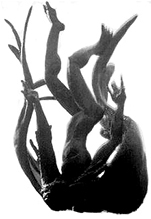
Where you are now ... that pit of despondency,
that crucible of pain is not of your choosing,
and if, by another, you find yourself there,
do not be deceived. You did not choose it. Another
did not force it upon you (although by all appearances
– much like dry cisterns — it would appear to
be). You are where you are for a purpose beyond
your immediate understanding. It seems impossible
to redeem, and no good can come of it for all
that you can see – and what of those who threw
you into the cistern, who left you to die, who
turned away indifferent to your pain, your fate?
Do you think that God will not use your suffering,
and even their malice, to an end unspeakably
good and known to Him alone?
In your pain do not imprecate, curse, those
who have brought it to you. Joseph had every
reason to, but did not. Joseph lived to see
this act of faith fulfilled. He was restored
to his beloved father, Jacob, and reconciled
with his brothers.
Another
died in an act of fulfillment ... and like Joseph
who prefigured Him, he, too, replied to the
presumption and the hubris of his tormentor
who foolishly thought himself the final arbiter
pursuing his own selfish ends:
“Non
haberes potestatem adversum me ullam, nisi tibi
datum esset desuper.” “You have no power
over Me, except it were given you from above.”
(St. John 19.11)
Understand this. There is redemption in your
suffering — but it will not
be on your terms. A far greater good lies
before you than the paltry immediacy of the
lesser good that you would choose.
Geoffrey K. Mondello
Editor
Boston Catholic Journal
 Printable PDF Version

Totally
Faithful to the Sacred
Deposit of Faith entrusted to
the Holy See in Rome
“Scio
opera tua ... quia modicum habes
virtutem, et servasti verbum Meum,
nec non negasti Nomen Meum”
“I
know your works ... that you have
but little power, and yet you have
kept My word, and have not denied
My Name.”
(Apocalypse 3.8)
Copyright
© 2004 - 2024 Boston Catholic Journal.
All rights reserved. Unless otherwise
stated, permission is granted by
the Boston Catholic Journal for
the copying and distribution of
the articles and audio files under
the following conditions:
No additions, deletions, or changes
are to be made to the text or audio
files in any way, and the copies
may not be sold for a profit. In
the reproduction, in any format
of any image, graphic, text, or
audio file, attribution must be
given to the Boston Catholic Journal.
|
|