








|
|
|
Few of us, I assume, would seek recourse to such a solution and for good reason. Legitimizing crime does not indemnify us against it — however much we hold ourselves to have abolished it. Yes?
We can say as much of sin.
In fact, we have said as much. Unlike the immediate consequences of crime, the consequences of sin — even temporally — are often deferred, less immediate ... and because we apprehend them as remote, as distant, as impending only, we dismiss them, for we fail to immediately see the terrible consequences they entail, consequences so terrible, so far-reaching, so much beyond our ken, that they have become effectively mythical.
And now, Holy
Confession …
I will now state something with which you are likely to disagree, and for good reason:
My parish Church is the holiest in all of Christendom; not just in the Archdiocese of Boston, but in all Massachusetts; very likely all New England — perhaps even the entire world.
You will disagree.
In fact, you know your own Catholic parish to be the holiest, perhaps the most sinless parish in the world, and we will both appeal to the same reasons for making this remarkable statement: during Holy Communion the pews are literally emptied.
There is not a sinner among us; at least no sinner guilty of Mortal Sin which prevents our going to Holy Communion, since — as Catholics should know — we add the tremendous sin of sacrilege to whatever mortal sin we carry if we receive Holy Communion while not in a state of grace — which is to say, free of Mortal Sin.
But as I ponder the empty pews, the stigma of being the sole sinner in the parish weighs heavily upon me as many look askance at my kneeling while all others scramble to make their way to Holy Communion — I at least wonder. Do Catholics, do all Catholics, do most Catholics, do at least some Catholics, even know what a Mortal Sin is anymore? Do they know the difference between a Mortal Sin that sunders the soul from God, and a Venial Sin that merely impedes its union with God?
Since the entire congregation have had at least eight years of Catechism, or Religious Education — eight to ten years, mind you! — surely so simple, so basic, so fundamental a concept, as the difference between serious sin and sins far less grievous in nature, is clearly apprehensible.
A
“Civil”
Analogy
A very ready analogy may be to the point: in the civic world, all of us know (probably because the penalty is clearly comprehended, immediate and forthcoming) the difference between grievously unlawful, or capital offenses such as murder and grand larceny, and misdemeanors, like receiving a speeding ticket or maliciously destroying a neighbor’s property. It is a no-brainer. We understand that there are sanctions and penalties involved with such behavior. It is, we are told, the means by which we maintain a “civil,” a mutually responsible, society.
We acknowledge the concept of justice and understand very clearly why it is maintained and what penalties are incurred if it is violated. We have no problem with that. After all, the law is not some gratuitous abstraction, and you are a fool if you think that you can trifle with it and walk away. If the breach is serious enough, you are clapped in irons, removed from the community, and deprived of your liberty until justice has exacted its tribute; until you have “paid your debt to society.” By and large we are grateful for the severity of the law, even as its rigors make us uneasy.
We all recognize that our own behavior has not always been unimpeachable ... if not clearly actionable. We do not personally legislate parallel laws that contravene the laws of the state and hold, at any point of divergence, the private interpretation of the law to abrogate the public law. It is the opposite which is true. We may find the laws of the state repugnant to us, unamenable to our own inclinations, even contrary to our own convictions — in which case we are confronted with three clearly distinguishable alternatives:
-
we can absent ourselves from the polity and choose to live elsewhere under a constitution that more closely corresponds with our desiderations and convictions, if such exists
-
we can continue to enjoy the collateral benefits in the present state that constrains us to abide by the laws through which it is defined and by which it is governed
-
or, we can seek to amend the law through the venues afforded us by the state.
What we cannot do is to enjoy the prerogatives of the state while either acting in defiance of it, or while subverting it. We understand this, and in fact underwrite it through maintaining our citizenship within it. We understand this broadly as a “pledge of allegiance.”
In any event, we cannot construct a private and parallel universe of statutes and anticipate that the public universe of affairs will recognize, respect, and honor our privately legislated laws. If we choose to abide only by those laws of the state that we do not find disagreeable to us, we have not attained to personal freedom, but to arbitrary license; not to civility, but to anarchy. We become both legislator and law. In such a solipsistic “society” the legislature and the corpus of law are as numerous as the individuals legislating them.
Well and good. Presumably we agree.
Otherwise madness ensues.
But what of God’s Law?
Why, we must ask ourselves, is
God’s
Law
somehow less important, less pertinent to our
behavior? Why does it have less bearing upon
our responsibilities and our choices — and,
most especially — within the Church? Is the Divine
Law, are the laws of the Church, no more than
pious and ultimately indolent sentiments — rather
than clearly articulated precepts with very
real corresponding sanctions and responsibilities
— in other words, coherent
laws?
Do we give tribute to Caesar but withhold it
from God? Is the Fasces mightier than
the Cross?
We are indeed a generation which had been nurtured on defiance to authority — only seeing now, in our own children, the fruit of that unbridled defiance which we nurtured in them even as we pretended to “deplore it.” Our children were ... “independent” ... not “defiant, and we were proud — until we began to detoxify them, to rehabilitate their behavior, to trade notes with our neighbors on “good analysts.” And our kids still get the keys to the car, no matter how grievous their transgression — just as we still get Holy Communion, no matter how grievous our offenses against God.
We are as blind to our sins as we have made our children blind to their own. After all, a “good parent” “spares the rod” and does not descend to “primitive behavior” such as punishing the child, no? And if we are such “good” parents — how much “better” God? Surely, there is no sin, no offense so grievous, or so trite, as to offend Him ... nothing we can ever do or say such that we would ever forfeit our “right,” not to the keys of the car but to the Kingdom of God, through the Bread of Angels ... Holy Communion — that you as arrogantly insist is as much your right as the keys to the car ...
Still pondering the empty pews, it would seem so.
Perhaps it is the case that all the parishioners are in fact guiltless of civil crime too, however petty (for these, also, are the stuff of Holy Confession) — as well as sin.
The truly defining question appears to be this: to whom, we must genuinely ask ourselves, do we owe more — to God or man? To the City of God or to the City of Man?
On your blithe way to Holy Communion, ponder this — especially given the ultimate sanction placed before us by no less an authority than Saint Paul:
“Whosoever shall eat this bread or drink the chalice of the Lord unworthily, shall be guilty of the Body and of the Blood of the Lord.” (I Cor. 11:27)
... are you prepared to add sacrilege to your sins?
Or has the notion of Sacrilege itself gone the way of Mortal Sin ... also?
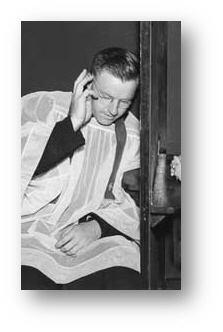
Go to Confession. You must go. It is the only antidote of Mortal Sin, and thus “the antidote of death”. St. Ignatius of Antioch (135 A.D.)
Geoffrey K. Mondello
Editor
Boston Catholic Journal
 Printable PDF Version
___________________________
Comments:
To the Editor:
“Just read ‘Mortal Sin and Holy Confession’. Another great reminder of what it means to be an orthodox Roman Catholic. I to, hope the empty pews can only mean that all who are receiving the Body and Blood of Christ are knowledgeable enough to know the difference between being in the state of grace and not being in the state of grace. I fear, like you, that our Vat II Catholic Church has miserably defeated its own purpose by not helping us to know the difference. I can only thank the good Lord that I was privileged to have a true Catholic education for 16 years and pray that I remember all that I was taught, Deo Volente, and I'm sure He is.
Keep up your encouraging work. Those of us in the trenches out here depend on your words of instruction and encouragement.”
JT (USMC)
Dear JT,
I agree with you about the lamentable state into which our Holy Mother the Church has been brought — and not so recently. It has been metastasizing like an aggressive cancer spreading to every tissue in every part of the Church, the Body of Christ — and it appears that very, very, few will call it out for what it has undeniably been, the state of denial in which it is in, in and what it is becoming. You may find the following article interesting in this regard, Jim: https://www.boston-catholic-journal.com/vatican-2-the-model-of-the-failed-corporation.htm Subsequent generations, I am convinced, will look back upon these grim years with not just sadness, but revulsion — and sorrow at the calculated loss of Faith by through so many who refused to pass it on (L. tradere), and at what cost to so many unfortunate souls? I will no man perdition, but I fear that very many are deserving of it … who have chosen the “wide and easy way.” However much they are admonished, they persist. The word “stupid” derives from the Latin “Stupidus:” to be struck, as with the hand, and made senseless. Regrettably, this is the cause, not the cure.
There is a cure for sin called Sanctifying Grace. But there is no cure for stupid.
Editor
Boston Catholic Journal
|
Totally Faithful
to the Sacred Deposit
of Faith entrusted to the Holy
See in Rome
|