










|
INDULGENCES
|
|
“I know my iniquity, and my sin is always before me.” (Psalm 50.5) |
And yet the same prophet tells us that,
|
“If thou, O Lord, wilt mark iniquities: Lord, who shall stand it. For with thee there is merciful forgiveness.” (Psalm 129.3) |
In light of this undeniable reality, how are we to understand the forgiveness of God afforded us in Holy and Sacramental Confession? On the one hand God forgives our sins ... while on the other He retains our punishment ... How is that the forgiveness extended to our sins does not extend to the punishment due sin? More simply put, does not forgiveness of the act entail remission of the punishment? In a word, no.
Justice and Satisfaction for Sin
First of all, not every sin is susceptible to restitution in the way, say, that the sin of stealing $100 can be rectified (not undone ...) by repaying the $100 to the person from whom it was stolen. This sinful act can be remediated by simply restoring what was wrongly taken. A lie can be redressed by telling the truth. However, this clearly is not the case with the sins of adultery and murder ... among many others. We cannot, of ourselves, restore, rehabilitate, or redress every sin. We cannot bring to life whom we have murdered. We cannot restore our virginity or that of another. We may be forgiven such sins but there is no path to restitution. This is to say that we cannot make satisfaction for them.
In such cases a commensurable privation, or punishment, is the only satisfaction possible in justice — and God is just (however frequently and conveniently overlooked). That justice is a good is indisputable. Were it not, then injustice would be good — and no one reasonable will argue this. God, then, Who is perfect, and perfectly good, cannot be wanting in any good, and we have agreed that justice is an indefeasible good. There is, in a word, no incongruity between God's goodness and God's justice. In fact, the two are both mutual and reciprocal. The notion of punishment, then, in no way derogates from God as good and God as just.
Since justice demands the atonement of sin, the punishment justly due sin must be satisfied either in this life or in the next. It appears inescapable. Satisfaction in this life is generally held by the Saints and Doctors of the Church to be less rigorous than the satisfaction exacted in the life to come. In this life or the next, justice will be satisfied.
But since all things are possible to God, why cannot the punishment due sin be commuted also? Since God is all good and all loving — as well as just — would He not make this at least possible? The answer to this question is precisely the point of this article.
The KEY to Understanding that All Things are Possible to God
The answer is yes.
To understand this, let us look at an analogy in secular life. The President of the United States, (or the Governor of any State) is granted the power of Executive Clemency, or the power to commute the sentence due in justice to an individual guilty of a crime ... even a capital offense. He exercises this power ex meru motu, or of his own accord, and independent of the sentence or penalty already delivered by a Court of Justice. This power is accorded him by Article II, Section 2 of the Constitution.
The question implicit in the exercise of this power is this: why would the President of the United States be granted — by the Constitution of the United States — this power to entirely commute the sentence delivered by a court that demands, and would exact, justice — if he was never intended to exercise it? In other words, why would any power be given any individual if it were never intended that the power so granted be exercised? The question, really, is rhetorical: it would be absurd to do so. Are we agreed?
Let us then look at Indulgences and the power to grant them by the Pope. It is a power explicitly granted him by no less an authority than Christ Himself in Sacred Scripture:
|
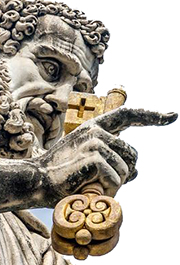
“And I say to thee: That thou art Peter; and upon this rock I will build my Church, and the gates of hell shall not prevail against it. And I will give to thee the keys of the kingdom of Heaven. And whatsoever thou shalt bind upon earth, it shall be bound also in Heaven: and whatsoever thou shalt loose on earth, it shall be loosed also in Heaven.” (St. Matthew 16.18-19) |
Let us re-frame the question we initially asked relative to Executive Clemency in the state of secular affairs: why would the Pope be granted — by Christ Himself — this power to entirely commute the demands of justice — if he was never intended to exercise it? In other words, why would the Pope be given this power if Christ never intended that the power so granted be exercised? Once again, such an assumption is absurd. If such power resides in the President of the United States through the Constitution — a fortiori ... that is to say, with greater force still, does the power to grant Plenary Indulgences reside in the Pope through Christ.
This is, literally,
the KEY to understanding Indulgences: the key
to Kingdom of Heaven given to Peter with a commission of such profound
authority that, Christ tells Peter,
“whatsoever
thou shalt bind upon earth, it shall be bound also in Heaven:
and whatsoever thou shalt loose on earth, it shall be loosed also
in heaven.”
Peter, the Pope, has power
that extends to Heaven itself, such that it is eo ipso ratified
by God Himself in Peter’s pronouncing it!
The State of Innocence Regained: undoing the done and unsaying the said
In acquiring a Plenary Indulgence one effectively regains the state of Baptismal Innocence. It is a stunning realization — and an unspeakable gift! It is nothing less than life absolutely anew in Christ! All that we had done in the way of sin has, through the Power of the Keys of Peter, been undone; all that had been said, is unsaid. They cease to be. Within our lives in Christ, these things no longer exist and never occurred. They have been totally abrogated, canceled, expunged, through the pronouncement of Peter — which is ipso facto ratified in Heaven itself!
In beginning this article, we had expressed the universal lamentation: “Ah ... would that I had never done that! Could I only go back in time!” You cannot go back in time. But what you have done can, after all — and to our amazement — be undone. But not of ourselves. This prerogative belongs to Peter, to the Pope, alone — to undo what we have done, to unsay what we have said. He has the power because he has been given the power — and he was given that power by Christ with a purpose and to an end. And Peter — the Pope — exercises this power, and is being faithful to this commission, in granting Plenary Indulgences to the Faithful under stipulations that he himself determines. And when he does — it is instantly ratified in Heaven!
Do you wish be truly, totally, free of the burden of your sins? Of the penalties — in justice demanded of them, and which, in all likelihood and with good reason, you fear when pondering the hour of your death ... and what lies beyond? Christ has spoken much of this.
But He also spoke to Peter — and through Peter, to us. A Plenary Indulgence — the forgiveness of all the sins of your entire life, and the punishment due in justice for them, is held out to you by God ... in the hands of Peter. 1
Why the Gaining of a Plenary indulgence
for Oneself is not a Selfish Act
First
we must understand two fundamental and extremely important features
about the dogma and doctrine of Plenary Indulgences:
-
The benefits of an indulgence can be applied to oneself.
-
Or they can be applied in the way of suffrage for the souls of the dead: We can ask God to grant the benefits of the indulgence that we claim (under very specific stipulations outlined in the Indulgentiarum Doctrina) to the soul of one we love who has died — with a clear understanding that the graces offered through the indulgence are God's Alone to give as He wills. In other words, He may very well accept your petition that the indulgence be granted to the specific person for whom you offer it. But we can never contravene, or violate, the free will of God; it is God’s prerogative to apply the indulgence that you offer to any soul Whom He chooses! It may be a soul in far greater need of the indulgence than the soul for whom you intended it. That soul then gains the merits of the indulgence you have claimed, rather than the soul for whom you petitioned. The indulgence is never lost, nor obtained in vain; it is, rather, granted according to the most holy will of God: for the person on whose behalf you offer it, or for another soul to Whom He chooses to apply its merits. Ultimately, God Alone knows upon whom He chooses to confer the merits of the indulgence that you have obtained. God is not heedless of our hearts. He knows the love and faith that motivates your offering of an indulgence for one who has been dear to you in this life. God honors and answers specific prayers that we place in humility and trust before Him. We know this. Holy Scripture is senseless apart from it. Whatever our intention, some soul, is granted that extraordinary grace, and goes to Heaven at once, beholding the very face of God! One day you will know whom, and it will be the person you have loved ... or another that will greet you in the company of Angels and Saints and reveal it to you. In either case your own joy will be overwhelming!
It has been asked: “Is it not selfish for me to apply the indulgence to myself, when I could have obtained it for another?”
No. And this is why: First we must remember Christ's admonition to us to remove the beam from our own eye before we attempt to remove it from the eye of another (St. Matthew 7.5). Holy Mother Church has always taught that our first obligation in the way of salvation and holiness, is to ourselves! We must pray for ourselves first before we can pray for others, seek to be holy ourselves before attempting to lead others to holiness. We must seek to be perfect even as our Father in Heaven is perfect (St. Matthew 5.48) until we can say with Saint Paul, “I live, now not I; but Christ liveth in me.” (Gal. 2.20). Such a soul is surely heard by God in every petition, yes? This is not to say that contrite sinners are not heard by God. We have the parable of the Publican and the Pharisee to testify to this (Saint Luke 18.10-14). It nevertheless remains that one free from sin and living in a state of grace is both pleasing to God and heard by Him. Within such a soul God sees His own Son, as Saint Paul tells us above. The stain of sin has been washed away, revealing the unmarred, unblemished, imago Dei (the image of God) in which it was created and in which there is no contrariety to God; in a word, a soul conformed to Christ Jesus.
So what?
When you yourself, for yourself, have obtained the graces and merits of a Plenary Indulgence that abrogates all temporal punishment and places you in a state of grace, conformed to God and free of sin together with its just punishment, you are then prepared to pray for others, to intercede for others. Your prayer is more efficacious because it is no longer simply you who plead, but Christ Jesus within you! “Jesus answered, and said to him: If any one love me, he will keep my word, and my Father will love him, and we will come to him, and will make our abode with him.” (St. John 14.23). In other words, through the Plenary Indulgence that you have claimed for yourself you have been cleansed of all the detritus of sin and every impediment before God — and are then enabled to more efficaciously pray for others! It is quite the opposite of selfishness: it is the impetus born of selfless love to pray more effectively for others — who have entrusted to you their own intentions, asking that you pray for them!
Do you think it presumptuous that the prayer of one who has obtained for himself the graces and merits of a Plenary Indulgence is more efficacious than the prayer of one who has not? Does it offend your democratic instincts that all should be heard equally by God, irrespective of their lives? The Parable of the Publican and the Pharisee is a beautifully inverse paradigm. “Democratically”, we vote for the Pharisee who is “blameless” and has the credentials, even as we abhor his self-righteousness (as God does, as well). The Publican has no credentials; just a list of the very reasons God should not hear him, but imploring God's mercy nonetheless. We know who walked away justified before God: the Publican who prayed, unlike the Pharisee who also prayed — but not both!
God heard the prayers of the Patriarch Joseph — but not those of his eleven brothers. Moses and Joshua were allowed into God's very Presence — but not Aaron or Levi. God heard — and answered — the prayers of Moses, but not of the grumbling Israelites. The list of examples of God answering the prayers of the just over the prayers of the unjust are innumerable. The point is that God hears all our prayers — but is especially inclined to answer the prayers of those who have spurned sin, the world, the flesh, and the devil — those who have washed their robes in the Blood of the Lamb. In our own day, who among us would presume that our own prayers were as likely to be answered as those of, say, Saint Padre Pio — to whom people flocked to present their own petitions to God? Indeed, why do we come to the holy Nun, Friar, Monk, or Priest to assist us with their prayers? Why, indeed, to the Saints at all? It is because throughout history we have recognized the extraordinary efficaciousness of the prayers of the holy (who, incidentally, never acknowledge themselves to be so) on our own behalf. Who has not petitioned another they deem holy to present their own needs to God, confident that God will answer because such a one — cleansed of sin, ever striving against it, and pleasing to God — will be heard and answered? And one becomes so — eminently — through a Plenary Indulgence first gained for themselves — in order to assist, through the love of Christ and neighbor, those who come to them in need, seeking their intercession before the God Who knows them — sees and hears His very Son within them — to Whom they have conformed their lives in contradiction to the world that never knew Him.
This is no selfish act simply to the end of ones own sanctification at which one stops, much like the Pharisee in the parable, satisfied that they have obtained salvation for themselves and heedless of the salvation of others. It is acquired precisely for the sanctification of others because once it is acquired for oneself it is subsequently, and all the more efficaciously, offered for others. So understood it is the ultimate act of the virtue of Spiritual Mercy (as distinct from acts of Corporal Mercy) in which the self, as the imago Dei, authentically reflects God Who is perfect in mercy. In a word, one becomes like unto God in reflecting and enacting the mercy we find in God Himself. Indeed, in so doing we find fulfilled the promise of Christ: “Blessed are the merciful, for they shall find mercy.” (Saint Matthew 5.7)
Editor
Boston Catholic Journal
 Printable
PDF Version
Printable
PDF Version
___________________________________________
1 Of course, the forgiveness extended by God for any sin and under all circumstances, presupposes and thus requires perfect Contrition, or sorrow, for the sins committed together with the resolute amendment to sin no more. Any petition to God for forgiveness of sins that is not accompanied by genuine sorrow is, in conspect Dei, that is to say, before God, an act of presumption and insolence, not reverence; and in the Holy Confessional constitutes the grave sin of blasphemy, such that the sinner leaves the Confessional, not only without absolution (even if the priest has pronounced it), but more guilty than when he entered it. Sorrow for sin is indispensable to its forgiveness.
Totally Faithful to the Sacred
Deposit of Faith entrusted to the Holy See in Rome
|