|
Purgatory: a Doctrine of Consolation
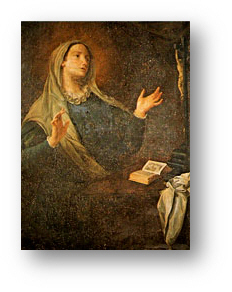
Saint
Catherine of Genoa’s
TREATISE ON
PURGATORY
“How
by Comparing it to the Divine Fire which she Felt in Herself,
this Soul Understood what Purgatory was like and how the Souls there
were Tormented.” 1
CHAPTER I
The state of the souls who are in Purgatory, how they are exempt
from all self-love.
This holy Soul
2
found herself, while still in the flesh, placed by the fiery love of
God in Purgatory, which burnt her, cleansing whatever in her needed
cleansing, to the end that when she passed from this life she might
be presented to the sight of God, her dear Love. By means of this loving
fire, she understood in her soul the state of the souls of the faithful
who are placed in Purgatory to purge them of all the rust and stains
of sin of which they have not rid themselves in this life. And since
this Soul, placed by the divine fire in this loving Purgatory, was united
to that divine love and content with all that was wrought in her, she
understood the state of the souls who are in Purgatory. And she said:
The souls who are in Purgatory cannot, as I understand, choose but be
there, and this is by God's ordinance who therein has done justly. They
cannot turn their thoughts back to themselves, nor can they say,
“Such
sins I have committed for which I deserve to be here”,
nor,
“I
would that I had not committed them for then I would go now to Paradise”,
nor,
“That
one will leave sooner than I”,
nor,
“I
will leave sooner than he”.
They can have neither of themselves nor of others any memory, whether
of good or evil, whence they would have greater pain than they suffer
ordinarily. So happy are they to be within God's ordinance, and that
He should do all which pleases Him, as it pleases Him that in their
greatest pain they cannot think of themselves. They see only the working
of the divine goodness, which leads man to itself mercifully, so that
he no longer sees aught of the pain or good which may befall him. Nor
would these souls be in pure charity if they could see that pain or
good. They cannot see that they are in pain because of their sins; that
sight they cannot hold in their minds because in it there would be an
active imperfection, which cannot be where no actual sin can be.
Only once, as they pass from this life, do they see the cause of the
Purgatory they endure; never again do they see it for in another sight
of it there would be self. Being then in charity from which they cannot
now depart by any actual fault, they can no longer will nor desire save
with the pure will of pure charity. Being in that fire of Purgatory,
they are SAINT CATHERINE OF GENOA within the divine ordinance, which
is pure charity, and in nothing can they depart thence for they are
deprived of the power to sin as of the power to merit.
CHAPTER II
What is the joy of the souls in Purgatory.
A comparison to show how they see God ever more and more. The difficulty
of speaking of this state.
I believe no happiness can be found
worthy to be compared with that of a soul in Purgatory except that of
the saints in Paradise; and day by day this happiness grows as God flows
into these souls, more and more as the hindrance to His entrance is
consumed. Sin's rust is the hindrance, and the fire burns the rust away
so that more and more the soul opens itself up to the divine inflowing.
A thing which is covered cannot respond to the sun's rays, not because
of any defect in the sun, which is shining all the time, but because
the cover is an obstacle; if the cover be burnt away, this thing is
open to the sun; more and more as the cover is consumed does it respond
to the rays of the sun.
It is in this way that rust, which is sin, covers souls, and in Purgatory
is burnt away by fire; the more it is consumed, the more do the souls
respond to God, the true sun. As the rust lessens and the soul is opened
up to the divine ray, happiness grows; until the time be accomplished
the one wanes and the other waxes. Pain however does not lessen but
only the time for which pain is endured. As for will: never can the
souls say these pains are pains, so contented are they with God's ordaining
with which, in pure charity, their will is united.
But, on the other hand, they endure a pain so extreme that no tongue
can be found to tell it, nor could the mind understand its least pang
if God by special grace did not show so much. Which least pang God of
His grace showed to this Soul, but with her tongue she cannot say what
it is. This sight which the Lord revealed to me has never since left
my mind and I will tell what I can of it. They will understand whose
mind God deigns to open.
CHAPTER III
Separation from God
is the chief punishment of Purgatory. Wherein Purgatory differs from
Hell.
All the pains of
Purgatory arise from original or actual sin. God created the soul pure,
simple and clean of all stain of sin, with a certain beatific instinct
towards Himself whence original sin, which the soul finds in itself,
draws it away, and when actual is added to original sin the soul is
drawn yet further away. The further it departs from its beatific instinct,
the more malignant it becomes because it corresponds less to God.
There can be no good save by participation in God, who meets the needs
of irrational creatures as He wills and has ordained, never failing
them, and answers to a rational soul in the measure in which He finds
it cleansed of sin's hindrance. When therefore a soul has come near
to the pure and clear state in which it was created, its beatific instinct
discovers itself and grows unceasingly, so impetuously and with such
fierce charity (drawing it to its last end) that any hindrance seems
to this soul a thing past bearing. The more it sees, the more extreme
is its pain.
Because the souls in Purgatory are without the guilt of sin, there is
no hindrance between them and God except their pain, which holds them
back so that they cannot reach perfection. Clearly they see the grievousness
of every least hindrance in their way, and see too that their instinct
is hindered by a necessity of justice: thence is born a raging fire,
like that of Hell save that guilt is lacking to it. Guilt it is which
makes the will of the damned in Hell malignant, on whom God does not
bestow His goodness and who remain therefore in desperate ill will,
opposed to the will of God.
CHAPTER IV
Of the state of the souls in Hell and of the difference between them
and those in Purgatory. Reflections of this saint on those who
are careless of their salvation.
Hence it is manifest that there is perversity of will, contrary to the
will of God, where the guilt is known and ill will persists, and that
the guilt of those who have passed with ill will from this life to Hell
is not remitted, nor can be since they may no longer change the will
with which they have passed out of this life, in which passage the soul
is made stable in good or evil in accordance with its deliberate will.
As it is written,
“Ubi
te invenero”,
that is in the hour of death, with the will to sin or dissatisfaction
with sin or repentance for sin,
“Ibi
te judicabo.”
Of which judgment there is afterwards no remission, as I will show:
After death free will can never return, for the will is fixed as it
was at the moment of death. Because the souls in Hell were found at
the moment of death to have in them the will to sin, they bear the guilt
throughout eternity, suffering not indeed the pains they merit but such
pains as they endure, and these without end. But the souls in Purgatory
bear only pain, for their guilt was wiped away at the moment of their
death when they were found to be ill content with their sins and repentant
for their offences against divine goodness. Therefore their pain is
finite and its time ever lessening, as has been said.
O misery beyond all other misery, the greater that human blindness takes
it not into account!
The pain of the damned is not infinite in quantity because the dear
goodness of God sheds the ray of His mercy even in Hell. For man dead
in sin merits infinite pain for an infinite time, but God's mercy has
allotted infinity to him only in time and has determined the quantity
of his pain; in justice God could have given him more pain.
O how dangerous is sin committed in malice! Hardly does a man repent
him thereof, and without repentance he will bear its guilt for as long
as he perseveres, that is for as long as he wills a sin committed or
wills to sin again.
CHAPTER V
Of the peace and the joy there are in
Purgatory.
The souls in Purgatory have wills
accordant in all things with the will of God, who therefore sheds on
them His goodness, and they, as far as their will goes, are happy and
cleansed of all their sin. As for guilt, these cleansed souls are as
they were when God created them, for God forgives their guilt immediately
who have passed from this life ill content with their sins, having confessed
all they have committed and having the will to commit no more. Only
the rust of sin is left them and from this they cleanse themselves by
pain in the fire. Thus cleansed of all guilt and united in will to God,
they see Him clearly in the degree in which He makes Himself known to
them, and see too how much it imports to enjoy Him and that souls have
been created for this end. Moreover, they are brought to so uniting
a conformity with God, and are drawn to Him in such wise, His natural
instinct towards souls working in them, that neither arguments nor figures
nor examples can make the thing clear as the mind knows it to be in
effect and as by inner feeling it is understood to be. I will, however,
make one comparison which comes to my mind.
CHAPTER VI
A comparison to show
with what violence and what love the souls in Purgatory desire to enjoy
God.
If in all the world
there were but one loaf of bread to feed the hunger of all creatures,
and if they were satisfied by the sight of it alone, then since man,
if he be healthy, has an instinct to eat, his hunger, if he neither
ate nor sickened nor died, would grow unceasingly for his instinct to
eat would not lessen. Knowing that there was only that loaf to satisfy
him and that without it he must still be hungry, he would be in unbearable
pain. All the more if he went near that loaf and could not see it, would
his natural craving for it be strengthened; his instinct would fix his
desire wholly on that loaf which held all that could content him; at
this point, if he were sure he would never see the loaf again, he would
be in Hell. Thus are the souls of the damned from whom any hope of ever
seeing their bread, which is God, the true Savior, has been taken away.
But the souls in Purgatory have the hope of seeing their bread and wholly
satisfying themselves therewith. Therefore they suffer hunger and endure
pain in that measure in which they will be able to satisfy themselves
with the bread which is Jesus Christ, true God and Savior and our Love.
CHAPTER VII
Of God's admirable wisdom in making Purgatory
and Hell.
As the clean and purified spirit
can find rest only in God, having been created for this end, so there
is no place save Hell for the soul in sin, for whose end Hell was ordained
by God. When the soul as it leaves the body is in mortal sin, then,
in the instant in which spirit and body are separated, the soul goes
to the place ordained for it, unguided save by the nature of its sin.
And if at that moment the soul were bound by no ordinance proceeding
from God's justice, it would go to a yet greater hell than that in which
it abides, for it would be outside His ordinance, in which divine mercy
has part so that God gives the soul less pain than it deserves. The
soul, finding no other place to hand nor any holding less evil for it,
casts itself by God's ordinance into Hell as into its proper place.
To return to our matter which is the Purgatory of the soul separated
from the body when it is no longer clean as it was created. Seeing in
itself the impediment which can be taken away only by means of Purgatory,
it casts itself therein swiftly and willingly. Were there not the ordinance
it thus obeys, one fit to rid it of its encumbrance, it would in that
instant beget within itself a hell worse than Purgatory, for it would
see that because of that impediment it could not draw near to God, its
end. So much does God import that Purgatory in comparison counts not
at all, for all that it is, as has been said, like Hell. But compared
to God, it appears almost nothing.
CHAPTER VIII
Of the necessity of
Purgatory. How terrible it is.
When I look at
God, I see no gate to Paradise, and yet because God is all mercy he
who wills enters there. God stands before us with open arms to receive
us into His glory. But well I see the divine essence to be of such purity,
greater far than can be imagined, that the soul in which there is even
the least note of imperfection would rather cast itself into a thousand
Hells than find itself thus stained in the presence of the Divine Majesty.
Therefore the soul, understanding that Purgatory has been ordained to
take away those stains, casts itself therein, and seems to itself to
have found great mercy in that it can rid itself there of the impediment
which is the stain of sin.
No tongue can tell nor explain, no mind understand, the grievousness
of Purgatory. But I, though I see that there is in Purgatory as much
pain as in Hell, yet see the soul which has the least stain of imperfection
accepting Purgatory, as I have said, as though it were a mercy, and
holding its pains of no account as compared with the least stain which
hinders a soul in its love. I seem to see that the pain which souls
in Purgatory endure because of whatever in them displeases God, that
is what they have willfully done against His so great goodness, is greater
than any other pain they feel in Purgatory. And this is because, being
in grace, they see the truth and the grievousness of the hindrance which
stays them from drawing near to God.
CHAPTER IX
How God and the souls
in Purgatory look at each other.
The saint acknowledges
that in speaking of these matters she cannot express herself.
All these things which I have surely in mind, in so much as in this
life I have been able to understand them, are, as compared with what
I have said, extreme in their greatness. Beside them, all the sights
and sounds and justice and truths of this world seem to me lies and
nothingness. I am left confused because I cannot find words extreme
enough for these things.
I perceive there to be so much conformity between God and the soul that
when He sees it in the purity in which His Divine Majesty created it
He gives it a burning love, which draws it to Himself, which is strong
enough to destroy it, immortal though it be, and which causes it to
be so transformed in God that it sees itself as though it were none
other than God. Unceasingly He draws it to Himself and breathes fire
into it, never letting it go until He has led it to the state whence
it came forth, that is to the pure cleanliness in which it was created.
When with its inner sight the soul sees itself drawn by God with such
loving fire, then it is melted by the heat of the glowing love for God,
its most dear Lord, which it feels overflowing it. And it sees by the
divine light that God does not cease from drawing it, nor from leading
it, lovingly and with much care and unfailing foresight, to its full
perfection, doing this of His pure love. But the soul, being hindered
by sin, cannot go whither God draws it; it cannot follow the uniting
look with which He would draw it to Himself. Again the soul perceives
the grievousness of being held back from seeing the divine light; the
soul's instinct too, being drawn by that uniting look, craves to be
unhindered. I say that it is the sight of these things which begets
in the souls the pain they feel in Purgatory. Not that they make account
of their pain; most great though it be, they deem it a far less evil
than to find themselves going against the will of God, whom they clearly
see to be on fire with extreme and pure love for them.
Strongly and unceasingly this love draws the soul with that uniting
look, as though it had nought else than this to do. Could the soul who
understood find a worse Purgatory in which to rid itself sooner of all
the hindrance in its. way, it would swiftly fling itself therein, driven
by the conforming love between itself and God.
CHAPTER X
How God uses Purgatory
to make the soul wholly pure. The soul acquires in Purgatory a purity
so great that were it well for it still to stay there after it had been
purged of sin, it would no longer suffer.
I see, too, certain rays and shafts of light which go out from that
divine love towards the soul and are penetrating and strong enough to
seem as though they must destroy not only the body but the soul too,
were that possible. Two works are wrought by these rays, the first purification
and the second destruction. Look at gold: the more you melt it, the
better it becomes; you could melt it until you had destroyed in it every
imperfection. Thus does fire work on material things. The soul cannot
be destroyed in so far as it is in God, but in so far as it is in itself
it can be destroyed; the more it is purified, the more is self destroyed
within it, until at last it is pure in God.
When gold has been purified up to twenty-four carats, it can no longer
be consumed by any fire; not gold itself but only dross can be burnt
away. Thus the divine fire works in the soul: God holds the soul in
the fire until its every imperfection is burnt away and it is brought
to perfection, as it were to the purity of twenty-four carats, each
soul however according to its own degree. When the soul has been purified
it stays wholly in God, having nothing of self in it; its being is in
God who has led this cleansed soul to Himself; it can suffer no more
for nothing is left in it to be burnt away; were it held in the fire
when it has thus been cleansed, it would feel no pain. Rather the fire
of divine love would be to it like eternal life and in no way contrary
to it.
CHAPTER XI
Of the desire of souls in Purgatory to
be wholly cleansed of the stains of their sins.
The wisdom of God who suddenly
hides their faults from these souls.
The soul was created as well conditioned as it is capable of being for
reaching perfection if it live as God has ordained and do not foul itself
with any stain of sin. But having fouled itself by original sin, it
loses its gifts and graces and lies dead, nor can it rise again save
by God's means. And when God, by baptism, has raised it from the dead,
it is still prone to evil, inclining and being led to actual sin unless
it resist. And thus it dies again.
Then God by another special grace raises it again, yet it stays so sullied
and so turned to self that all the divine workings of which we have
spoken are needed to recall it to its first state in which God created
it; without them it could never get back thither. And when the soul
finds itself on the road back to its first state, its need to be transformed
in God kindles in it a fire so great that this is its Purgatory. Not
that it can look upon this as Purgatory, but its instinct to God, aflame
and thwarted, makes Purgatory.
A last act of love is done by God without help from man. So many hidden
imperfections are in the soul that, did it see them, it would live in
despair. But in the state of which we have spoken they are all burnt
away, and only when they have gone does God show them to the soul, so
that it may see that divine working which kindles the fire of love in
which its imperfections have been burnt away.
CHAPTER XII
How suffering in Purgatory
is coupled with joy.
Know that what man deems
perfection in himself is in God's sight faulty, for all the things a
man does which he sees or feels or means or wills or remembers to have
a perfect seeming are wholly fouled and sullied unless he acknowledge
them to be from God. If a work is to be perfect it must be wrought in
us but not chiefly by us, for God's works must be done in Him and not
wrought chiefly by man.
Such works are those last wrought in us by God of His pure and clean
love, by Him alone without merit of ours, and so penetrating are they
and such fire do they kindle in the soul, that the body which wraps
it seems to be consumed as in a furnace never to be quenched until death.
It is true that love for God which fills the soul to overflowing, gives
it, so I see it, a happiness beyond what can be told, but this happiness
takes not one pang from the pain of the souls in Purgatory. Rather the
love of these souls, finding itself hindered, causes their pain; and
the more perfect is the love of which God has made them capable, the
greater is their pain. So that the souls in Purgatory enjoy the greatest
happiness and endure the greatest pain; the one does not hinder the
other.
CHAPTER XIII
The souls in Purgatory
are no longer in a state to acquire merit. How these souls look on the
charity exercised for them in the world.
If the souls in
Purgatory could purge themselves by contrition, they would pay all their
debt in one instant such blazing vehemence would their contrition have
in the clear light shed for them on the grievousness of being hindered
from reaching their end and the love of God.
Know surely that not the least farthing of payment is remitted to those
souls, for thus has it been determined by God's justice. So much for
what God does as for what the souls do, they can no longer choose for
themselves, nor can they see or will, save as God wills, for thus has
it been determined for them.
And if any alms be done them by those who are in the world to lessen
the time of their pain, they cannot turn with affection to contemplate
the deed, saving as it is weighed in the most just scales of the divine
will. They leave all in God's hands who pays Himself as His infinite
goodness pleases. If they could turn to contemplate the alms except
as it is within the divine will, there would be self in what they did
and they would lose sight of God's will, which would make a Hell for
them. Therefore they await immovably all that God gives them, whether
pleasure and happiness or pain, and never more can they turn their eyes
back to themselves.
CHAPTER XIV
Of the submission of the souls in Purgatory
to God's will.
So intimate with God are the souls
in Purgatory and so changed to His will, that in all things they are
content with His most holy ordinance. And if a soul were brought to
see God when it had still a trifle of which to purge itself, a great
injury would be done it. For since pure love and supreme justice could
not brook that stained soul, and to bear with its presence would not
befit God, it would suffer a torment worse than ten purgatories. To
see God when full satisfaction had not yet been made Him, even if the
time of purgation lacked but the twinkling of an eye, would be unbearable
to that soul. It would sooner go to a thousand hells, to rid itself
of the little rust still clinging to it, than stand in the divine presence
when it was not yet wholly cleansed.
CHAPTER XV
Reproaches which the souls in Purgatory
make to people in the world.
And so that
blessed 3 soul, seeing the aforesaid things by the divine
light, said:
“I
would fain send up a cry so loud that it would put fear in all men on
the earth. I would say to them: 'Wretches, why do you let yourselves
be thus blinded by the world, you whose need is so great and grievous,
as you will know at the moment of death, and who make no provision for
it whatsoever?”
“You
have all taken shelter beneath hope in God's mercy, which is, you say,
very great, but you see not that this great goodness of God will judge
you for having gone against the will of so good a Lord. His goodness
should constrain you to do all His will, not give you hope in ill-doing,
for His justice cannot fail but in one way or another must needs be
fully satisfied.
“Cease
to hug yourselves, saying: 'I will confess my sins and then receive
plenary indulgence, and at that moment I shall be purged of all my sins
and thus shall be saved.' Think of the confession and the contrition
needed for that plenary indulgence, so hardly come by that, if you knew,
you would tremble in great fear, more sure you would never win it than
that you ever could.”
CHAPTER XVI
This
Soul shows again how the sufferings of the souls in Purgatory are no
hindrance at all to their peace and their joy.
I see the souls suffer the pains
of Purgatory having before their eyes two works of God.
First, they see themselves suffering pain willingly, and as they consider
their own deserts and acknowledge how they have grieved God, it seems
to them that He has shown them great mercy, for if His goodness had
not tempered justice with mercy, making satisfaction with the precious
blood of Jesus Christ, one sin would deserve a thousand perpetual hells.
And therefore the souls suffer pain willingly, and would not lighten
it by one pang, knowing that they most fully deserve it and that it
has been well ordained, and they no more complain of God, as far as
their will goes, than if they were in eternal life.
The second work they see is the happiness they feel as they contemplate
God's ordinance and the love and mercy with which He works on the soul.
In one instant God imprints these two sights on their minds, and because
they are in grace they are aware of these sights and understand them
as they are, in the measure of their capacity. Thus a great happiness
is granted them which never fails; rather it grows as they draw nearer
God. These souls see these sights neither in nor of themselves but in
God, on whom they are far more intent than on the pains they suffer,
and of whom they make far greater account, beyond all comparison, than
of their pains. For every glimpse which can be had of God exceeds any
pain or joy a man can feel. Albeit, however, it exceeds the pain and
joy of these souls, it lessens them by not a little.
CHAPTER XVII
She concludes by applying all she has
said of the souls in Purgatory to what she feels, and has proved in
her own soul.
This form of purgation, which I
see in the souls in Purgatory, I feel in my own mind. In the last two
years I have felt it most; every day I feel and see it more clearly.
I see my soul within this body as in a purgatory, formed as is the true
Purgatory and like it, but so measured that the body can bear with it
and not die little by little it grows until the body die.
I see my spirit estranged from all things, even things spiritual, which
can feed it, such as gaiety, delight and consolation, and without the
power so to enjoy anything, spiritual or temporal, by will or mind or
memory, as to let me say one thing contents me more than another.
Inwardly I find myself as it were besieged. All things by which spiritual
or bodily life is refreshed have, little by little, been taken from
my inner self, which knows, now they are gone, that they fed and comforted.
But so hateful and abhorrent are these things, as they are known to
the spirit, that they all go never to return. This is because of the
spirit’s
instinct to rid itself of whatever hinders its perfection; so ruthless
is it that to fulfill its purpose it would all but cast itself into
Hell. Therefore it ever deprives the inner man of all on which it can
feed, besieging it so cunningly that it lets not the least atom of imperfection
pass unseen and unabhorred.
As for my outer man, it too, since the spirit does not respond to it,
is so besieged that it finds nothing to refresh it on the earth if it
follow its human instinct. No comfort is left it save God, who works
all this by love and very mercifully in satisfaction of His justice.
To perceive this gives my outer man great peace and happiness, but happiness
which neither lessens my pain nor weakens the siege. Yet no pain could
ever be inflicted on me so great that I would wish to depart from the
divine ordinance. I neither leave my prison nor seek to go forth from
it: let God do what is needed! My happiness is that God be satisfied,
nor could I suffer a worse pain than that of going outside God's ordinance,
so just I see Him to be and so very merciful.
All these things of which I have spoken are what I see and, as it were,
touch, but I cannot find fit words to say as much as I would of them.
Nor can I say rightly what I have told of the work done in me, which
I have felt spiritually. I have told it however.
The prison in which I seem to myself to be is the world, my chains the
body, and it is my soul enlightened by grace which knows the grievousness
of being held down or kept back and thus hindered from pursuing its
end. This gives my soul great pain for it is very tender. By God's grace
it receives a certain dignity which makes it like unto God; nay, rather
He lets it share His goodness so that it becomes one with Him. And since
it is impossible that God suffer pain, this immunity too befalls the
souls who draw near Him; the nearer they come to Him, the more they
partake of what is His.
Therefore to be hindered on its way, as it is, causes the soul unbearable
pain. The pain and the hindrance wrest it from its first natural state,
which by grace is revealed to it, and finding itself deprived of what
it is able to receive, it suffers a pain more or less great according
to the measure of its esteem for God. The more the soul knows God, the
more it esteems Him and the more sinless it becomes, so that the hindrance
in its way grows yet more terrible to it, above all because the soul
which is unhindered and wholly recollected in God knows Him as He truly
is.
As the man who would let himself be killed rather than offend God feels
death and its pain, but is given by the light of God a zeal which causes
him to rate divine honor above bodily death, so the soul who knows God's
ordinance rates it above all possible inner and outer torments, terrible
though they may be, for this is a work of God who surpasses all that
can be felt or imagined. Moreover God when He occupies a soul, in however
small a degree, keeps it wholly busied over His Majesty so that nothing
else counts for it. Thus it loses all which is its own, and can of itself
neither see nor speak nor know loss or pain. But, as I have already
said clearly, it knows all in one instant when it leaves this life.
Finally and in conclusion, let us understand that God who is best and
greatest causes all that is of man to be lost, and that Purgatory cleanses
it away.
END OF THE TREATISE ON PURGATORY
First Published 1946 By Sheed
And Ward, Inc. 63 Fifth Avenue New York
Nihil Obstat: Ernestus C. Messenger, Ph.D, Censor Deputatus
Imprimatur: E. Morrogh Bernard Vic. Gen.
Westmonasterii, die 18 Decembris 1945
________________________________________
FOOTNOTES
1 The chapter headings are unlikely to have been written by Saint Catherine,
who would hardly refer to herself as a saint, as implied in the headings
to Chapter IV and IX.
2 At least the word
“holy”
and perhaps all this introductory paragraph were probably added by whoever
wrote the chapter headings
3 This epithet, and perhaps all this sentence down to
“said”,
has probably been added by an editor
About Saint Catherine of Genoa
(courtesy of
EWTN)
Saint
Catherine of Genoa
was born
in the Vicolo del Filo in that city, in 1447. She was of the great Guelph
family of Fiesca, being the daughter of Giacomo Fiesca, at one time
Viceroy of Naples, and granddaughter of Roberto Fiesca, whose brother
was Pope Innocent IV. Another Fiesca was Pope Adrian V; for this family
gave several princes to the Church and many bold and skillful warriors
and statesmen to the state. The saint's mother, Francesca de Negro,
was likewise of aristocratic birth.
Catherine, who was one of five children, was brought up piously. Her
earliest biography, written by the priest Cattaneo Marabotto, who was
her confessor in her latter years, and by her friend Ettore Vernazza,
relates that her penances were remarkable from the time she was eight,
and that she received the gift of prayer in her thirteenth year. When
she was thirteen she declared to her confessor her wish to enter the
convent of Santa Maria delle Grazie, in Genoa, a house of Augustinian
Canonesses of the Lateran in which her elder sister Limbania had already
taken the veil. He pointed out to her that she was still very young
and that the life of a religious was hard, but she met his objections
with a "prudence and zeal" which seemed to him "not human but supernatural
and divine ". So he visited the convent of her predilection, to which
he was confessor, and urged the mothers to accept her as a novice. But
they were obdurate against transgressing their custom by receiving so
young a girl. Catherine's disappointment gave her "great pain, but she
hoped the Lord Almighty would not forsake her."
She grew up to be very lovely:
“taller
than most women, her head well proportioned, her face rather long but
singularly beautiful and well shaped, her complexion fair and in the
flower of her youth rubicund, her nose long rather than short, her eyes
dark and her forehead high and broad; every part of her body was well
formed.”
About the time she failed to enter the convent, or a little later, her
father died, and his power and possessions passed to her eldest brother
Giacomo. Wishing to compose the differences between the factions into
which the principal families of Genoa were divided--differences which
had long entailed cruel, distracting and wearing strife--Giacomo Fiesca
formed the project of marrying his young sister to Giuliano Adorni,
son of the head of a powerful Ghibelline family. He obtained his mother's
support for his plan, and found Giuliano willing to accept the beautiful,
noble and rich bride proposed to him; as for Catherine herself, she
would not refuse this cross laid on her at the command of her mother
and eldest brother. On the 13th of January, 1463, at the age of sixteen,
she was married to Giuliano Adorni.
He is described as a man of "strange and recalcitrant nature" who wasted
his substance on disorderly living. Catherine, living with him in his
fine house in the Piazza Sant' Agnete, at first entirely refused to
adopt his worldly ways, and lived "like a hermit", never going out except
to hear Mass. But when she had thus spent five years, she yielded to
the remonstrances of her family, and for the next five years practiced
a certain commerce with the world, partaking of the pleasures customary
among the women of her class but never falling into sin. Increasingly
she was irked and wearied by her husband's lack of spiritual sympathy
with her, and by the distractions which kept her from God.
Her conversion is dated from the eve of St. Bernard, 1474, when she
visited the church of St. Bernard, in Genoa, and prayed, so intolerable
had life in the world become to her, that she might have an illness
which would keep her three months in bed. Her prayer was not granted
but her longing to leave the world persisted. Two days later she visited
her sister Limbania in the convent of Santa Maria delle Grazie, and
at Limbania's instance returned there on the morrow to make her confession
to the nuns' confessor. Suddenly, as she was kneeling down at the confessional,
"her heart was wounded by a dart of God's immense love, and she had
a clear vision of her own wretchedness and faults and the most high
goodness of God. She fell to the ground, all but swooning", and from
her heart rose the unuttered cry,
“No
more of the world for me! No more sin!”
The confessor was at this moment called away, and when he came back
she could speak again, and asked and obtained his leave to postpone
her confession.
Then she hurried home, to shut herself up in the most secluded room
in the house, and for several days she stayed there absorbed by consciousness
of her own wretchedness and of God's mercy in warning her. She had a
vision of Our Lord, weighed down by His Cross and covered with blood,
and she cried aloud,
“O
Lord, I will never sin again; if need be, I will make public confession
of my sins.”
After a time, she was inspired with a desire for Holy Communion which
she fulfilled on the feast of the Annunciation.
She now entered on a life of prayer and penance. She obtained from her
husband a promise, which he kept, to live with her as a brother. She
made strict rules for herself--to avert her eyes from sights of the
world, to speak no useless words, to eat only what was necessary for
life, to sleep as little as possible and on a bed in which she put briars
and thistles, to wear a rough hair shirt. Every day she spent six hours
in prayer. She rigorously mortified her affections and will.
Soon, guided by the Ladies of Mercy, she was devoting herself to the
care of the sick poor. In her plain dress she would go through the streets
and byways of Genoa, looking for poor people who were ill, and when
she found them she tended them and washed and mended their filthy rags.
Often she visited the hospital of St. Lazarus, which harbored incurables
so diseased as to be horrible to the sight and smell, many of them embittered.
In Catherine they aroused not disgust but charity; she met their insults
with unfailing gentleness.
Her earliest biography gives details of her religious practices. From
the time of her conversion she hungered insatiably for the Holy Eucharist,
and the priests admitted her to the privilege, very rare in that period,
of daily communion. For twenty-three years, beginning in the third year
after her conversion, she fasted completely throughout Lent and Advent,
except that at long intervals she drank a glass of water mixed with
salt and vinegar to remind herself of the drink offered to Our Lord
on the cross, and during these fasts she enjoyed exceptional health
and vigor. For twenty-five years after her conversion she had no spiritual
director except Our Lord Himself. Then, when she had fallen into the
illness which afflicted the last ten years of her life, she felt the
need for human help, and a priest named Cattaneo Marabotto, who had
a position of authority in the hospital in which she was then working,
became her confessor.
Some years after her conversion her husband was received into the third
order of St. Francis, and afterwards he helped her in her works of mercy.
The time came when the directors of the great hospital in Genoa asked
Catherine to superintend the care of the sick in this institution. She
accepted, and hired near the hospital a poor house in which she and
her husband lived out the rest of their days. Her prayers were still
long and regular and her raptures frequent, but she so arranged that
neither her devotions nor her ecstasies interfered with her care of
the sick. Although she was humbly submissive even to the hospital servants,
the directors saw the value of her work and appointed her rector of
the hospital with unlimited powers.
In 1497 she nursed her husband through his last illness. In his will
he extolled her virtues and left her all his possessions.
Mrs. Charlotte Balfour underlined in her copy of the saint's works an
indicative extract from her teaching.
“We
should not wish for anything but what comes to us from moment to moment,”
Saint Catherine told her spiritual children,
“exercising
ourselves none the less for good. For he who would not thus exercise
himself, and await what God sends, would tempt God. When we have done
what good we can, let us accept all that happens to us by Our Lord's
ordinance, and let us unite ourselves to it by our will. Who tastes
what it is to rest in union with God will seem to himself to have won
to Paradise even in this life.”
She was still only fifty-three years old when she fell ill, worn out
by her life of ecstasies, her burning love for God, labor for her fellow
creatures and her privations; during her last ten years on earth she
suffered much. She died on the 15th of September, 1510, at the age of
sixty-three. The public cult rendered to her was declared legitimate
on the 6th of April, 1675. The process for her canonization was instituted
by the directors of the hospital in Genoa where she had worked. Her
heroic virtue and the authenticity of many miracles attributed to her
having been proved, the bull for her canonization was issued by Clement
XII on the 30th of April, 1737.
Saint Catherine's authorship of the
“Treatise
on Purgatory”
has never been disputed. But Baron von Hugel in his monumental work
the
“Mystical
Element in Religion as Studied in Saint Catherine of Genoa and her Friends”
concludes convincingly, after a meticulous examination of the
“Dialogue
of the Blessed and Seraphic Saint Catherine of Genoa,”
that its author was Battista Vernazza: The entire
“Dialogue”
then is the work of Battista Vernazza." Thus this work is not, as has
been thought, the saint's spiritual autobiography, nor indeed does it
ever claim to be other than what it is, her spiritual biography. It
is the life of her soul, dramatized by a younger woman who had known
her and her intimates, who had a singular devotion to her, and who was
peculiarly qualified to understand her experience.
Baron von Hugel believed that Saint Catherine first became acquainted
with the Genoese notary Ettore Vernazza during the epidemic in Genoa
in 1493, that is nineteen years after her conversion, when she was forty-six
years old and he in his early twenties. She wrote of
“a
great compassion he had conceived when still very young, at the time
the pestilence raged in Genoa, when he used to go about to help the
poor”.
Von Hugel describes him, after profound study of his life and works,
as "a man of fine and keen, deep and world-embracing mind and heart,
of an overflowing, ceaseless activity, and of a will of steel”.
He was
“the
most intimate, certainly the most perceptive of Catherine's disciples”
and with Cattaneo Marabotto wrote the earliest life of her. In 1496
he married Bartolomea Ricci, and they had three daughters of whom the
eldest, Tommasa, had Saint Catherine for godmother.
Little Tommasa was a sensitive, loving, bright child with a turn for
writing, as she showed in a few simple lines of verse which she wrote
to her
“most
holy protectress”
and
“adored
mother”
when she was only ten. Was she addressing her godmother, or her mother
in the flesh who died not long afterwards? Her father, after his wife's
death, sent her and her little sister Catetta to board in that convent
of Augustinian canonesses in which Saint Catherine had not been allowed
to take the veil. Perhaps the nuns had been taught by the saint that
very young girls may have a true vocation to religion, for Tommasa was
only thirteen when, on the 24th of June, 1510, she received in their
house the habit of an Augustinian Canoness of the Lateran and changed
her name to Battista. She spent all the rest of her ninety years on
earth in that convent in Genoa.
Twelve weeks after her reception Saint Catherine died, and Baron von
Hugel tentatively identifies Battista with an unnamed nun to whom, and
to six other friends and disciples of the saint, Battista's father among
them, "intimations and communications of her passage and instant complete
union with God" were vouchsafed at the moment of her death.
Battista's literary remains include many letters, poetry--both spiritual
canticles and sonnets, and several volumes of spiritual dissertations
in which are
“all
but endless parallels and illustrations”
to the teachings of Saint Catherine. She wrote also three sets of
“Colloquies”,
and in one of them relates certain of her own spiritual experiences.
In all her writings, but especially in these narrations, Baron von Hugel
notes the influence of Catherine's doctrine and spiritual practices.
The
“Dialogue”
reproduces the incidents of the saint's spiritual life as these are
recorded in her earliest biography, and its doctrine is that embodied
in the
“Treatise
on Purgatory”
and in her recorded sayings, from which even its language is in large
part derived. That its matter has passed through another mind, Battista's,
gives it an added interest: there is the curious, vivid dramatization;
there is, in some passages, a poignant and individual quality; and there
is an insight which proves that Battista herself was also a mystic,
one who had spent all her days in the spiritual companionship of Saint
Catherine. We are shown not only the saint but also her reflection in
the mirror which was Battista's mind.
“A
person”,
says Von Hugel, speaking of Battista at the time when she wrote the
“Dialogue”,
“living
now thirty-eight years after Catherine's death, in an environment of
a kind to preserve her memory green.... Battista, the goddaughter of
the heroine of the work, and the eldest, devoted daughter of the chief
contributor to the already extant biography; a contemplative with a
deep interest in, and much practical experience of, the kind of spirituality
to be portrayed and the sort of literature required; a nun during thirty-eight
years in the very convent where Catherine's sister, one of its foundresses,
had lived and died, and where Catherine herself had desired to live
and where her conversion had taken place.”
The
“Dialogue”,
long generally accepted as Catherine's own account of her spiritual
life, has been allowed by the highest authorities to embody, with her
“Treatise
on Purgatory,”
the saint's doctrine. These two treatises and the earliest biography,
translated into several languages, spread that doctrine and devotion
to her throughout the Catholic world in the centuries between her death
and her canonization. The bull which canonized her alludes to the
“Dialogue"
as an exposition of her doctrine: "In her admirable "Dialogue" she depicts
the dangers to which a soul bound by the flesh is exposed.”
The Vicomte Theodore Marie de Bussierne includes the
“Dialogue
”with
the
“Treatise
on Purgatory”
in his translation into French of the saint's works, published in 1860.
It was from this translation that Mrs. Charlotte Balfour translated
the first half of the
“Dialogue”
into English. She meant to make an English version of all the saint's
works but had worked only on the
“Dialogue”
at the time of her death. Her work has been carefully collated with
the Italian original and revised where necessary, the edition used being
that included in the beautiful
“Life
and Works”
of Saint Catherine which was printed in Rome in 1737, the year of her
canonization, by Giovanni Battista de Caporali, and dedicated to Princess
Vittoria Altoviti de' Corsini, the Pope's niece. As here printed, the
whole Dialogue may be regarded as translated from Battista Venazza's
original work. Mrs. Balfour would certainly have wished to acknowledge
her debt to Monsieur de Bussierne's French version. The latter part
of the Dialogue and the whole
“Treatise
on Purgatory”
have been directly translated from the 1737 Italian edition of the saint's
works.
Saint Catherine's earliest biography concludes with the following words:
“It
remains for us to pray the Lord, of His great goodness and by the intercession
of this glorious Seraphim, to give us His love abundantly, that we may
not cease to grow in virtue, and may at last win to eternal beatitude
with God who lives and reigns for ever and ever.”
H.D.I.
Editor
Boston Catholic Journal
 Printable PDF Version

Totally Faithful to the Sacred
Deposit of Faith entrusted to the Holy See in Rome
“Scio
opera tua ... quia modicum habes virtutem, et servasti verbum
Meum, nec non negasti Nomen Meum”
“I
know your works ... that you have but little power, and
yet you have kept My word, and have not denied My Name.”
(Apocalypse
3.8)
Copyright © 2004 - 2026 Boston Catholic
Journal. All rights reserved. Unless otherwise stated, permission
is granted by the Boston Catholic Journal for the copying
and distribution of the articles and audio files under the
following conditions: No additions, deletions, or
changes are to be made to the text or audio files in any
way, and the copies may not be sold for a profit. In the
reproduction, in any format of any image, graphic, text,
or audio file, attribution must be given to the Boston Catholic
Journal.
|
|